



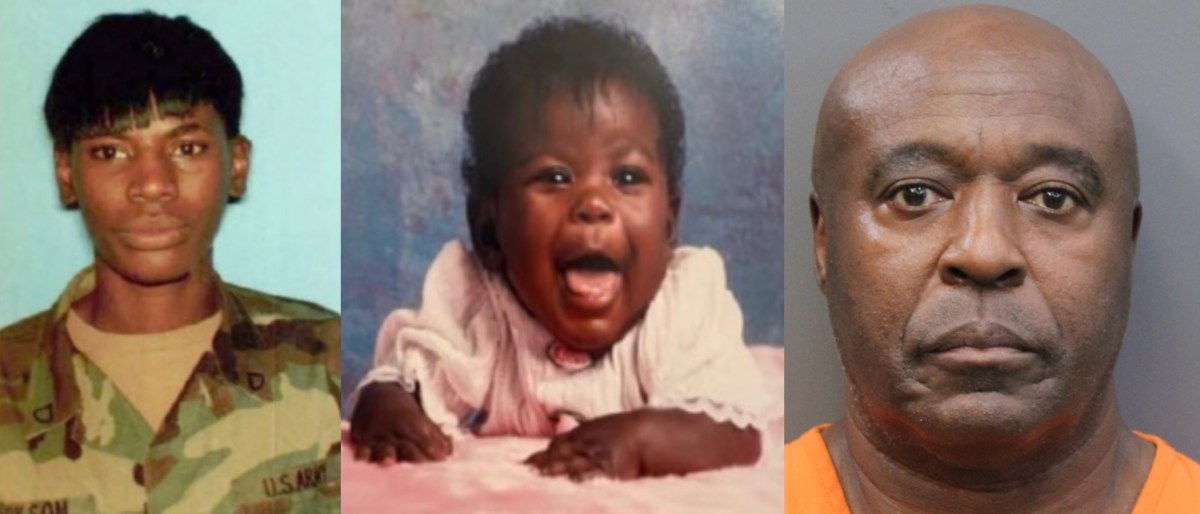
A Florida man reportedly charged with the cold case murder a Gulf War veteran whose remains — and those of her daughter — were found near Gilgo Beach serial killer victims has waived extradition.
Andrew Dykes, 66, of Tampa, was arrested on Dec. 3 on a warrant for second-degree murder charge that Nassau County authorities filed, according to court records. Dykes is accused of killing Tanya Jackson, whose remains were partly found in Lakeview in 1997 and near Jones Beach in 2011 — and who was known only as “Peaches,” for her tattoo, until Nassau authorities identified her in August — according to multiple reports. The remains of her approximately 2-year-old daughter, Tatiana Dykes, was found a few miles east on Ocean Parkway near Cedar Beach, on the Suffolk County side of the barrier island.
“It’s his child, and he was on the birth certificate,” former NYPD Chief of Detectives Robert Boyce told WABC7-TV. “That’s how they found his name.”
Andrew Dykes signed court documents waiving an extradition hearing in Florida the day after his arrest, records show. The Hillsborough County Sheriff’s Office is currently holding him without bail. It was not immediately clear when authorities would transport him back to Nassau to face the charge.
Hillsborough officials referred requests for comment to Nassau police, who referred calls to Nassau prosecutors, who declined to comment. Suffolk prosecutors also referred calls to Nassau authorities.
“Solving aging cases like these are extraordinarily challenging … but we will never give up,” Nassau County District Attorney Anne Donnelly had told reporters during a news conference this summer when authorities revealed that they identified the victims.
Peaches’ torso was found inside a container in the woods next to McDonald Pond at Hempstead Lake State Park in 1997 by a conservation officer during a fishing derby. A photo of her tattoo – a bitten peach – was released to the public to help authorities identify her.
Her extremities, initially dubbed Jane Doe No. 3, and her child were found in spring of 2011 during a massive search authorities undertook after finding the first four Gilgo Beach serial killer victims in December 2010. But it was years before authorities confirmed that the remains were connected.
In 2016, the Press broke the news that Peaches and Jane Doe 3 were the same individual. The revelation was sparked by the work of filmmakers Joshua Zeman and Rachel Mills, who produced A&E’s The Killing Season investigating the Gilgo case and other cold case murders, as well as the work of Websleuths.
In 2020, the FBI was tapped to use genetic genealogy to help identify the victim formerly known as Peaches and her daughter. Two years later, the Mobile Police Department in Alabama released Peaches’s tattoo on its Facebook page, seeking relatives of an Elijah “Lige” Howell, who died in 1964 and whose relatives may have been able to assist in identifying Peaches. Howell had multiple siblings but no known children at the time of his death.
FBI agents and Nassau detectives ultimately tracked down the victim’s estranged family, interviewed them and confirmed her identity using DNA, officials said. A private funeral was held over the summer.
Rex Heuermann, an architect from Massapequa Park, has pleaded not guilty to charges of murdering six other women whose remains were found in the bayside brush along the westbound side of Ocean Parkway, as well as a seventh victim found dead in 1993 in the Hamptons. Jackson and her daughter were found at opposite ends of the area where the other victims were found in that case. Heuermann is due back in court on Jan. 13.