


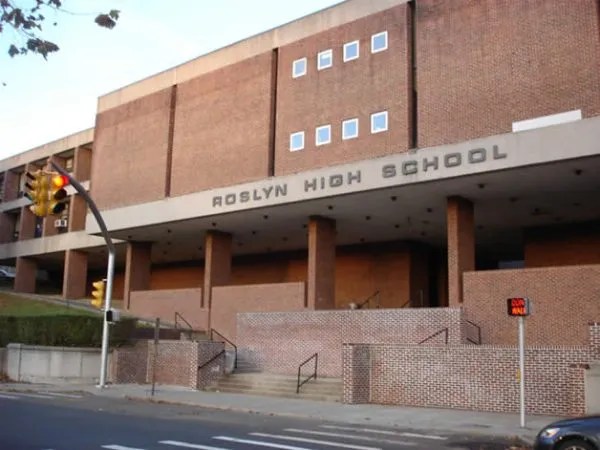
Two pedestrian fatalities connected to Roslyn stunned the community last week and raised questions about pedestrian safety in Nassau County.
The first was the death of 53-year-old Elena Crowley, a beloved security aide at Roslyn High School, wife and mother of two, who was struck by a pickup truck while at the intersection of Lufberry Avenue and Briard Street in Wantagh.
Crowley’s sudden death was felt well beyond her family.
“Elena was more than a colleague; she was a vital part of our school family,” Roslyn Superintendent Allison Brown wrote in an email to students’ parents. “She worked tirelessly to ensure the safety and well-being of our students and staff. Her kindness and vigilance will be deeply missed, and her absence will be felt throughout our entire community.”
Brown said counseling services would be available for students, staff and families as the district copes with the loss.
Earlier Monday, 69-year-old Claudia Moncada of Glen Cove was killed while crossing Glen Cove Road in neighboring Greenvale by a red 2018 Dodge Challenger.
There is less information about Moncada. But that does not lessen the questions of how two pedestrians connected to Roslyn could be killed in two separate incidents within hours of each other.
Sadly, that question is increasingly raised.
Nassau County’s fatality rate has been higher than the state average. And traffic fatalities rose from 67 to at least 78 in 2025, according to a fatality tracker published by one newspaper company.
A heavy reliance on cars, a rise in aggressive driving, and roadway designs that put pedestrians and cyclists at risk have been seen as the biggest reasons for the county’s higher-than-average rate. Perhaps, we should add a lack of data available to officials and residents.
The need to rely on a media company’s own tracking system stems from Nassau’s decentralized system that is based on police press releases and the state database, which may not report fatalities until, on average, 10 months later.
Nassau’s system contrasts with New York City, where fatalities are reported within days, appear on the city’s Vision Zero map, which is intended to reduce traffic fatalities, and are included in monthly reports.
The city, which has made pedestrian fatalities a focus, also offers a public dashboard that shows crash locations and fatalities in real time.
There are no up-to-date numbers for pedestrian fatalities in Nassau County in 2026.
The county should develop a centralized system to track traffic deaths in real time, including where they occur, to help officials address the problem. We believe the county, working with the state, villages, and towns,
In 2025, according to the Tri-Stat Transportation Campaign, a non-profit seeking to improve pedestrian safety, the deadliest roads for pedestrians in Nassau County were:
- Hempstead Turnpike running through Elmont, Franklin Square, West Hempstead, East Meadow and Levittown;
- Sunrise Highway, Valley Stream, Lynbrook, Rockville Centre, Freeport and Massapequa;
- Jericho Turnpike through Floral Park, New Hyde Park, Mineola, Westbury, Jericho and Syosset;
- Merrick Road through the South Shore from Lynbrook to Massapequa;
- Northern Boulevard through Great Neck, Manhasset and Roslyn.
These corridors share common traits: high speeds, wide lanes, heavy commercial traffic and long crossing distances.
New York City has addressed pedestrian fatalities with street redesign, lower speed limits, automated enforcement, and new laws, such as making drivers who fail to yield and injure or kill pedestrians face criminal charges. In its first year, pedestrian deaths declined 45% compared with the year before. Overall, traffic deaths have declined more than 12%.
In 2025, the city’s pedestrian deaths totaled 206 compared to the county’s 78.
Nassau County implemented its first Vision Zero-style plan in 2018, but responsibility is divided between county, state, and town governments, and implementation has been slower.
We believe the county, working with the state, villages, and towns, should develop additional plans to make these roadways safer for pedestrians. There are a wide variety of options, from increased enforcement of speeding to narrowing travel lanes to building curb extensions.
That would be a fitting way to honor the lives of Elena Crowley, Claudia Moncada and the many other unnecessary pedestrian fatalities