



She survived many heartbreaking losses during her life: Her activist husband and their four children, all under 5 years old, died of yellow fever in 1867, when she was just 30. Her dressmaking shop, home, and all her possessions were destroyed in the Great Chicago Fire of 1871, leaving her a poor Irish immigrant and widow. But later in life, she found her purpose: Raise hell as a union organizer and orator.
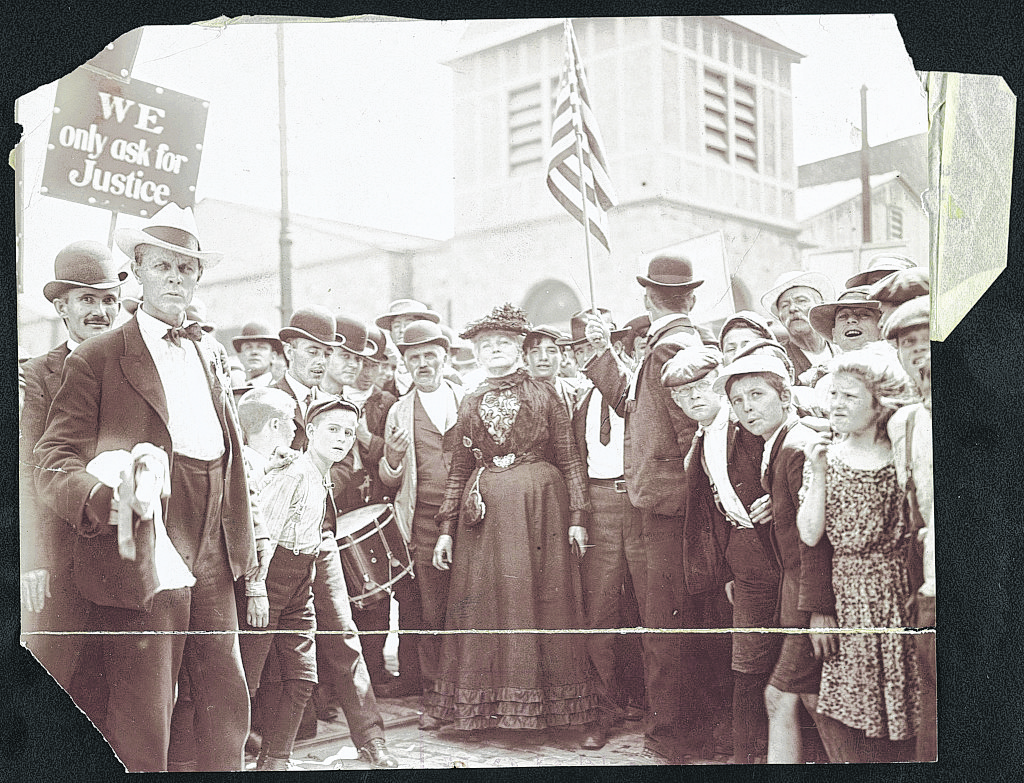
Her energetic, passionate presence resonated with the entire country over the years, and on July 7, 1903, at the age of 70, Mary Harris “Mother” Jones set out as the leader of a 125-mile march of textile laborers. The event dubbed “The March of the Mill Children” and “The Children’s Crusade” saw Jones lead 100 children from Philadelphia to the Summer White House in Oyster Bay, Long Island. Her goal was to inform President Theodore Roosevelt of the brutal conditions for children working in clothing mills — many of whom were maimed, crippled, or killed in mill accidents — and demand a 55-hour work week.
Several days into the march, as reported by The New York Times, she told a crowd on 5,000 in New Jersey, “Our cause is a just one and we propose to show the New York millionaires our grievances.” She had written three pleas for a meeting before deciding to make the journey, but the president did not respond.
When she and the children arrived in Oyster Bay after their three-week-long trek, the president snubbed her, refusing to meet with her and the children; His secretary informed her that Roosevelt was unavailable.
DISPOSSESSED AND DOWNTRODDEN
As a young child living in Cork, Ireland, Jones faced hardships that would motivate her later. She was just 10 years old in 1847 when the devastating potato famine forced her family to leave Ireland. They moved to Toronto, Canada when she was a teenager. She became a skilled dressmaker and studied to be a teacher during the Civil War at a time when teaching was a low-salary profession for women. She traveled throughout the U.S., teaching in various schools. After the Chicago Fire, she helped rebuild the city, joining the Knights of Labor, the largest American labor movement of the 19th century, and becoming an organizer for the United Mine Workers of America.
She was 50 when she became a full-time union organizer for striking mine workers, which included African American workers, women, and children. She staged parades with children carrying signs that read, “We Want to Go to School and Not to the Mines,” according to aflcio.org. She was labeled “the most dangerous woman in America” by a U.S. district attorney because she was adept at organizing thousands of workers to go on strike against powerful industries.
Author and muckraker Upton Sinclair described Jones as an old, wrinkled little woman dressed in antique black dresses, who looked like somebody’s grandmother; “She was, in truth, the grandmother of hundreds of thousands of miners,” he wrote.
Starting in 1897, the fiery speaker in matronly black dresses became known as “Mother Jones” because of her outfits and references to the workers she fought for as “her boys.” Like many others in women’s history who faced prejudice and unfair treatment, she was banished from more towns and held incommunicado in more jails in more states than any other union leader of the time, as reported by the aflcio.org. But still, she persisted. The war cry of this passionate voice of American radicalism was “Pray for the dead, and fight like hell for the living.’’ And she excelled at publicizing the causes she championed, which included lax enforcement of child labor which saw children as young as 5 years old working in mines factories, and agriculture.
THE ROAD TO ROOSEVELT
In one of the speeches she made to audiences while on the children’s march from the textile mills of Philadelphia, as published by the Zinn Education Project, she stated that she would ask the president to recommend the passage of a bill by Congress to protect “children against the greed of the manufacturer … children, who never have a chance to go to school, but work from 10 to 11 hours a day in the textile mills of Philadelphia, weaving the carpets that he and you walk on, and the curtains and clothes of the people.”
The media coverage generated by the march to Oyster Bay caught the nation’s attention and bolstered Jones’ efforts to abolish child labor. In 1904 the National Child Labor Committee was founded and a year later, Pennsylvania toughened its child labor laws. Jones’ dedication laid the foundation which took 35 years to come to fruition, but in 1938, the Fair Labor Standards Act, nationwide legislation protecting young workers, was passed.
She would continue to organize and raise hell until her death in 1930 at the age of 100.