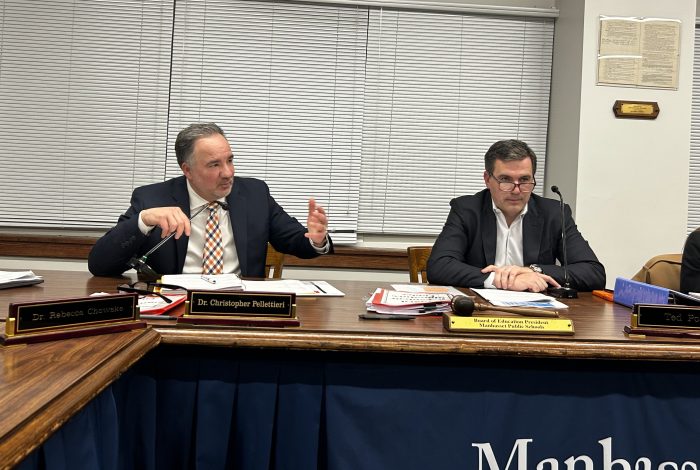




The Port Washington Union Free School District Board of Education on Tuesday, March 24 laid out a preliminary 2026–’27 budget that would increase spending by 3.43% while keeping the tax levy at 3.25%, as administrators pointed to rising employee benefit costs while proposing new investments in staffing, instruction and facilities.
As the budget adoption is scheduled for April 14, Board President Adam Smith noted that district leaders have also been meeting with state representatives to advocate for additional financial aid and greater flexibility in allocating funding.
Superintendent Gaurav Passi said the district is navigating a shift in state funding, as both the state Senate and Assembly have proposed increases to foundation aid above the governor’s initial 1% proposal.
“We are encouraged to see movement in both houses, and remain hopeful that the final budget will include a more favorable adjustment,” he said.
Passi added that expanded universal pre-K requirements under discussion in Albany could significantly affect the district in coming years, stating that partnerships with community-based organizations may be necessary “given our space constraints.”
The proposed budget is driven largely by rising employee costs, which now account for about 73% of total spending. However, administrators said the plan remains within the district’s tax levy limit, while relying in part on a projected 7.5% increase in state aid under the governor’s proposal.
A major portion of the presentation focused on staffing, which district leaders framed as central to improving instruction and student performance. The proposal includes a net increase of four full-time positions, bringing the total to 966 employees, along with targeted additions such as instructional coaches in math, a special education teacher and an additional elementary math AIS teacher.
The budget also calls for eliminating math chairperson roles and creating a districtwide director of mathematics, business and computer science, which became a point of criticism during public comment.
Regina McLean, president of the Port Washington Teachers Association, said the union “continues to oppose this idea,” stating that replacing multiple chairs with a single administrator would disconnect leadership from classrooms.
“Why replace chairs, who cost less than $20,000 per year, with a director who would cost over $200,000?” she said. “That is an additional $200,000 every single year. This is a budgetary blow, not a necessity.”
Beyond staffing, a recent facilities study found that three schools no longer need planned electrical upgrades, freeing about $1.875 million to return to the capital reserve.
The board is expected to adopt a final budget proposal on April 14 before it goes to voters on May 19.