


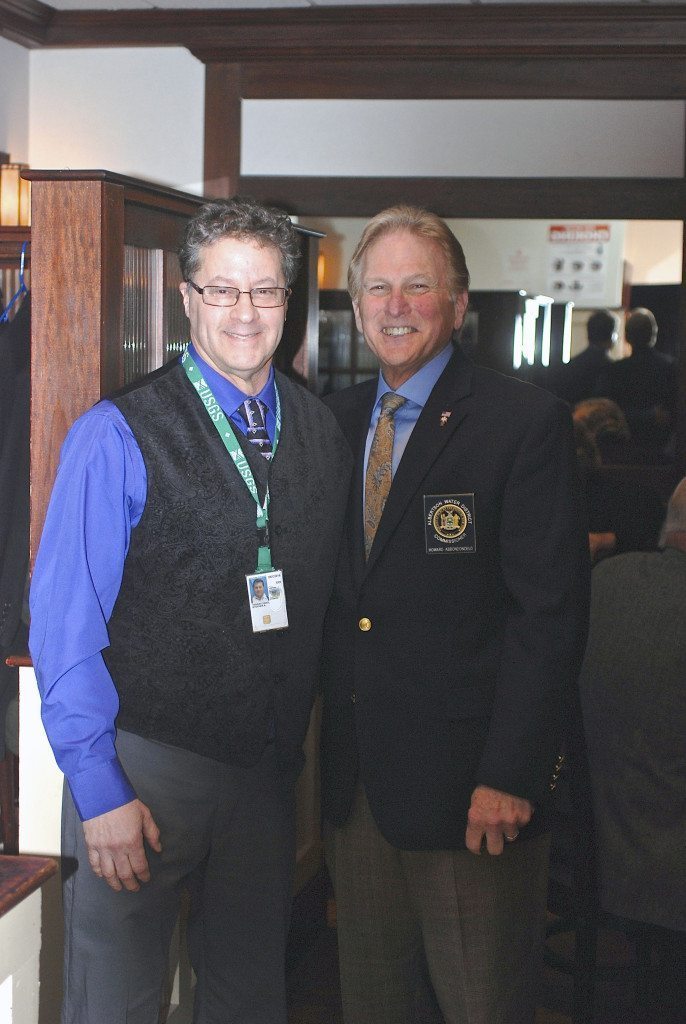
 At a recent meeting held by Nassau Suffolk Water Commissioners’ Association, of which Massapequa Water District’s Thomas P. Hand is first vice president, Raymond J. Averna is second vice president and Joseph Tricarico is a member, Office Chief of the U.S. Geological Survey program Stephen Terracciano spoke about the USGS’ mission and latest findings regarding Long Island’s water supply.
“Data indicates that urbanization of western Long Island has had a significant effect on the underlying water resources,” said Terracciano. “Installation of sewers and storm drains, along with large scale pumpage, has caused significant declines in water levels. This has led to reduction in streamflow, loss of wetlands, saltwater intrusion, basement and subway flooding.”
Water resources are affected by many factors, both natural and man-made, including climate change, storms, population growth and land-use. On Long Island, the USGS collects hydrologic data through a network of stations that monitor wells, streams, lakes, estuaries and meteorological posts. This data is collected, organized and used to identify trends and influences on the water system including water supply, salt water intrusion, climate, population, drought and flood monitoring.
A national science-based organization, the U.S. Geological Survey has provided the public with impartial information on the health of our environment, ecosystems and natural resources, including water supply, for over 100 years. On Long Island, the organization is currently sustained by a shared funding program to which the NSWCA has supported and contributed $50,000.