



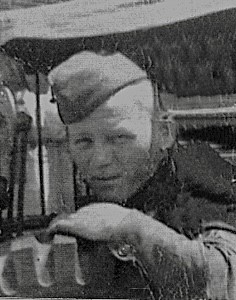
After nearly three-quarters of a century, U.S. Army Sergeant George Michael Barbiere of Hicksville has finally been accounted for.
Barbiere, who was reported missing in action during the Korean War on Dec. 2, 1950, near the Chosin Reservoir in North Korea, was officially identified on Feb. 26, 2025, by the Defense POW/MIA Accounting Agency (DPAA). He was 23 years old at the time of his death. His remains had been previously buried as an unknown in the National Memorial Cemetery of the Pacific—commonly known as the Punchbowl—in Honolulu.
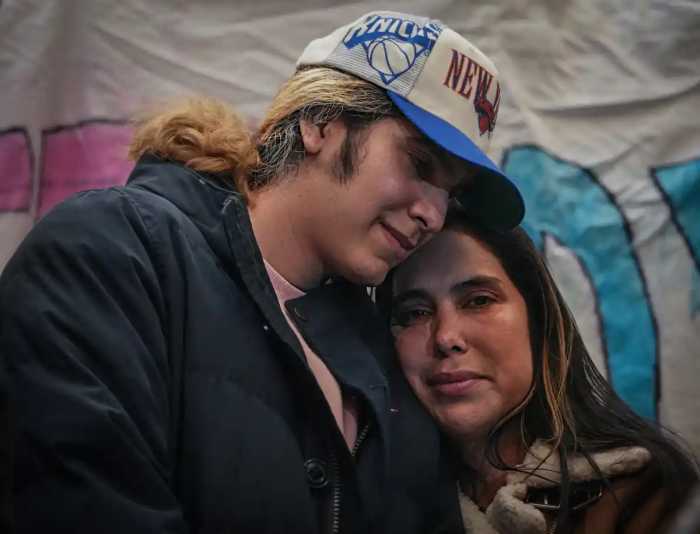
“It’s bittersweet news,” said Gary Morando, Barbiere’s nephew and the son of his only surviving sibling, Rose Marie Morando (née Barbiere).
Morando, who grew up in Centerport and served in the U.S. Army from 1988 to 1994, said the identification has brought long-awaited closure to his family. “George was my mom’s brother,” he said. “She said goodbye to him when she was 17 and he was 20. She knew he was going into the Army—but they never saw each other again.”
On the evening of Nov. 27, 1950, Chinese Communist Forces (CCF) launched a massive attack against the U.S. and United Nations troops stationed in the Chosin Reservoir area in northeast North Korea, resulting in a 17-day conflict that became known as the Battle of Chosin Reservoir.
At the time of the initial CCF attack, members of the U.S. Army’s 31st and 32nd Infantry Regiments were defending the area north of Sinhung-ni, on the east side of the reservoir.
The defenders were overwhelmed by the numerically superior CCF and were forced to withdraw to friendly lines at Hagaru-ri on Dec. 1. Chinese roadblocks from Sinhung-ni to Hagaru-ri, along with constant enemy fire from the surrounding high ground, made the withdrawal route extremely dangerous.
Eventually, the column was broken into separate segments, which the CCF attacked individually. Many men were lost or captured during the moving battle, with survivors reaching friendly lines in Hagaru-ri on Dec. 2 and 3.
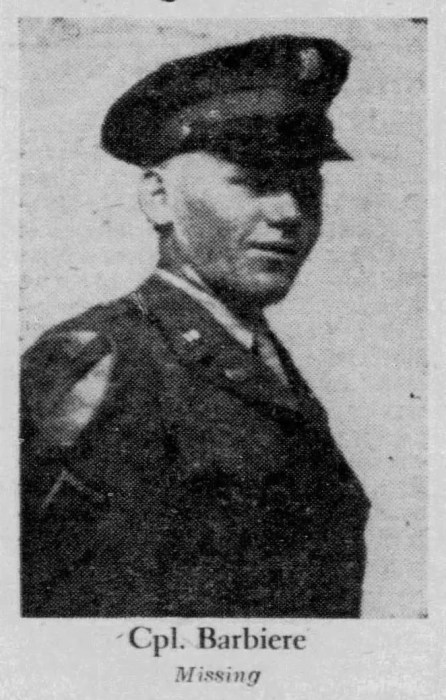
Barbiere was a member of the Service Company, 32nd Infantry Regiment, 7th Infantry Division and was among the thousands of American troops involved in the brutal Battle of Chosin Reservoir. Barbiere was among those lost during the perilous withdrawal toward friendly lines at Hagaru-ri. He was never reported as a prisoner of war.
His body was not recovered during or immediately after the battle. Although the Department of Defense announced Barbiere’s presumed death, along with five other men from Long Island, after one year of being identified as missing in action. In 1954, Chinese Communist Forces returned the remains of U.S. personnel during Operation Glory, but one set—labeled as Unknown X-15759—could not be identified at the time and was interred at the Punchbowl.
As part of a larger effort to identify Korean War unknowns, DPAA disinterred those remains in 2021. Using dental records, anthropological analysis and mitochondrial DNA comparisons from family members, scientists confirmed the remains belonged to Sgt. Barbiere.
Morando began researching his uncle’s story in 1995, long before the family expected an identification.
“I started researching him through the Korean War Memorial website,” he said. “You could put in someone’s name and unit and get a list of others in the same unit. I started cold-calling people—finally, after days and days, I got someone on the line who knew him. It was pretty wild.”
Born and raised on Long Island, Barbiere and his siblings spent their early years in places like Huntington and Hicksville. “We don’t have a lot of details about George,” Morando said. Records show that Barbiere, son of Michael and Mary, graduated from South Huntington High School in 1948.
In 1950, the local newspaper announcement initially reporting Barbiere as “missing in action” said that he was active in baseball and basketball while in high school. It also said, “A good singer, he was a member of the high school’s glee club and a proficient wood carver. He was nicknamed ‘Steely’ by his high school chums.”
Barbiere had no children and none of his nieces or nephews ever met him—he died 14 years before Morando was born in 1964. Still, Morando says the impact of his uncle’s sacrifice has echoed through generations.
The final chapter in Barbiere’s story will take place at Arlington National Cemetery, where he will be buried with full military honors. A date for the interment has not yet been set.
Barbiere’s name is etched on the Courts of the Missing at the Punchbowl in Honolulu, alongside other soldiers still unaccounted for from the Korean War. A rosette will now be placed next to his name to signify that he has been found.
Morando and his family—his mom, Rose Marie, and siblings James, Greg, and Sharon—plan to honor Barbiere’s legacy as they finally lay him to rest.
“It’s been a long time coming,” said Morando. “But George is finally coming home.”
For more information on the Department of Defense’s mission to account for Americans missing in action, visit www.dpaa.mil.