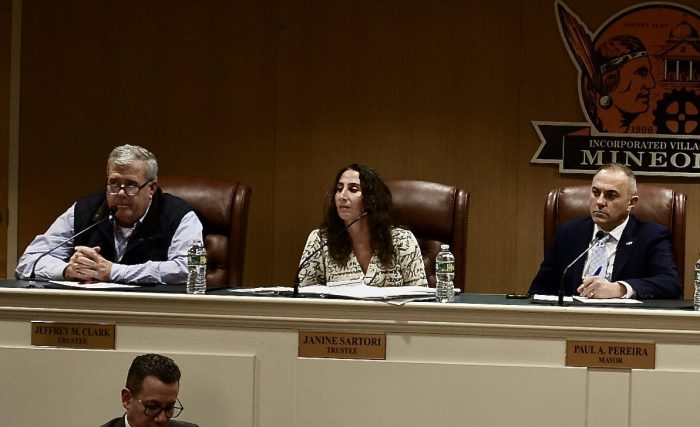




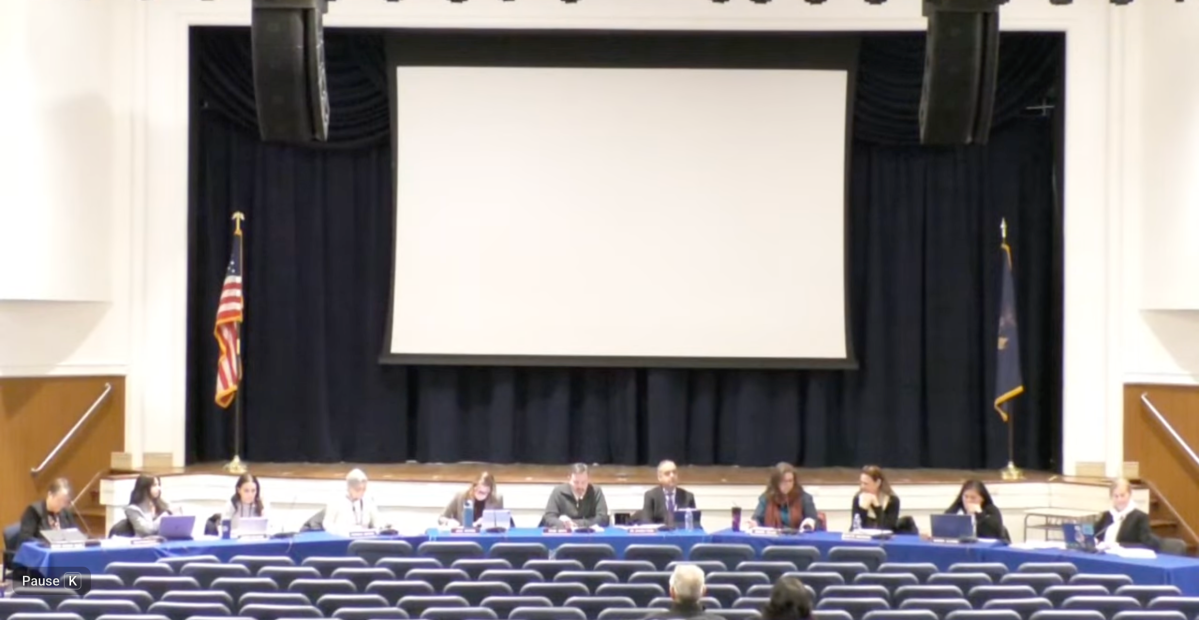
The Port Washington Board of Education met Jan. 20 to discuss early-stage planning for the district’s 2026–27 budget, starting a months-long process that will end with a public vote on May 19.
Board President Adam Smith described the process as “fluid and iterative,” stressing that all proposals remain in draft form until a final budget is adopted in April. A preliminary budget is expected in March.
One of the largest challenges to the district’s finances is a projected 9% increase in health insurance premiums, a cost that officials said is difficult to absorb in a tax-cap environment. Superintendent Gaurav Passi noted that 73% of the district’s budget is tied to staffing and benefits.
Officials also pointed to a few factors that could help offset those increases.
The district has recorded 17 retirements, which administrators estimate will save about $1.5 million as higher-paid staff are replaced with new hires. The district received a tax-base growth factor, allowing for roughly $1.5 million in additional levy capacity under the state tax cap.
Assistant Superintendent of Business Kathleen Manuel said the district also received updated state “need estimates.” While foundation aid is projected to rise by just 1%, which she described as a “little discouraging,” expense-based aid and pre-kindergarten funding appear to be increasing. She said the data is still being analyzed.
Administrators said proposed changes at the national level could affect Title I, II and III grants, which support professional development, literacy and math instruction, and after-school programs for English Language Learners. If those funds are reduced or eliminated, the district would have to decide whether to cover those costs through its general budget.
During public comment, community members and students raised concerns about how potential changes could affect the district’s Latin program, urging the board not to eliminate it from the curriculum.
A parent spoke in support of the district’s Latin program, stating that studying Latin and the classics helped her children stand out in the college admissions process. She also argued that the subject plays an important role in developing language and critical thinking skills.
“I urge you, do not cripple this district by removing the study of Latin and the humanities in this very competitive North Shore of Long Island environment,” she said. “In addition, the study of Latin, a non-romance but not dead language, offers special learners with speech or auditory processing issues, like myself, my son, an opportunity to learn the language comfortably without the pressure or the fear of having to speak up in class.”
Isabella Ertel and Charlie Paredes, co-presidents of the Paul D. Schreiber’s Latin Club, echoed those concerns, describing the program as academically rigorous and personally meaningful.
Ertel credited the program and her long-term relationship with her teacher as key factors in her college acceptance.
“For us, Latin isn’t just about academics,” said Ertel. “We’ve noticed that it connects us to the foundations of our own history, government, literature and philosophy. When we read Latin, we learn so much about where our culture, our ideas and our systems come from.”
In response, Passi clarified that a recent retirement in the middle school Latin department prompted the district to pause and reassess its language offerings for incoming sixth graders. She said the district’s top priority is ensuring that students currently studying Latin can continue through graduation if they choose.
“We are working to make sure that the students who are currently in the Latin pipeline are able to complete their studies,” he said.
Another community member came forward to ask whether the district has a contingency plan to offer virtual instruction to vulnerable families who may be afraid to send their children to school due to national immigration-related fears. She suggested appointing a bilingual community liaison to support affected families.
The board will review the rollover budget and tax cap on Feb. 10, present a preliminary budget on March 10, and adopt the final budget in April.