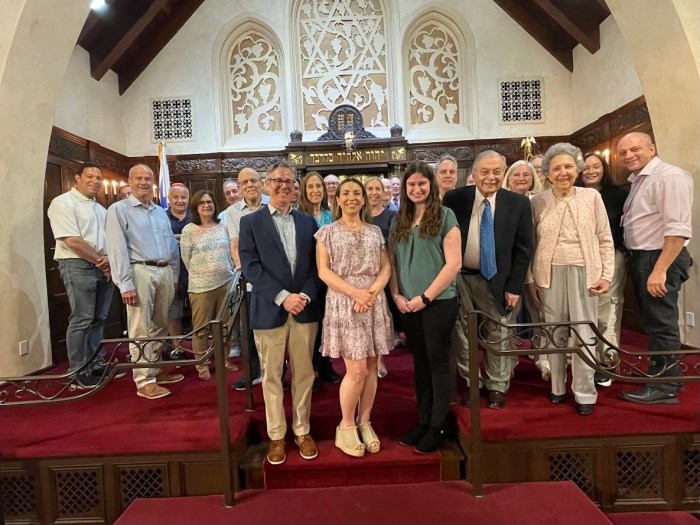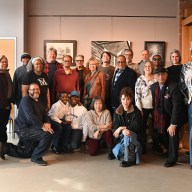




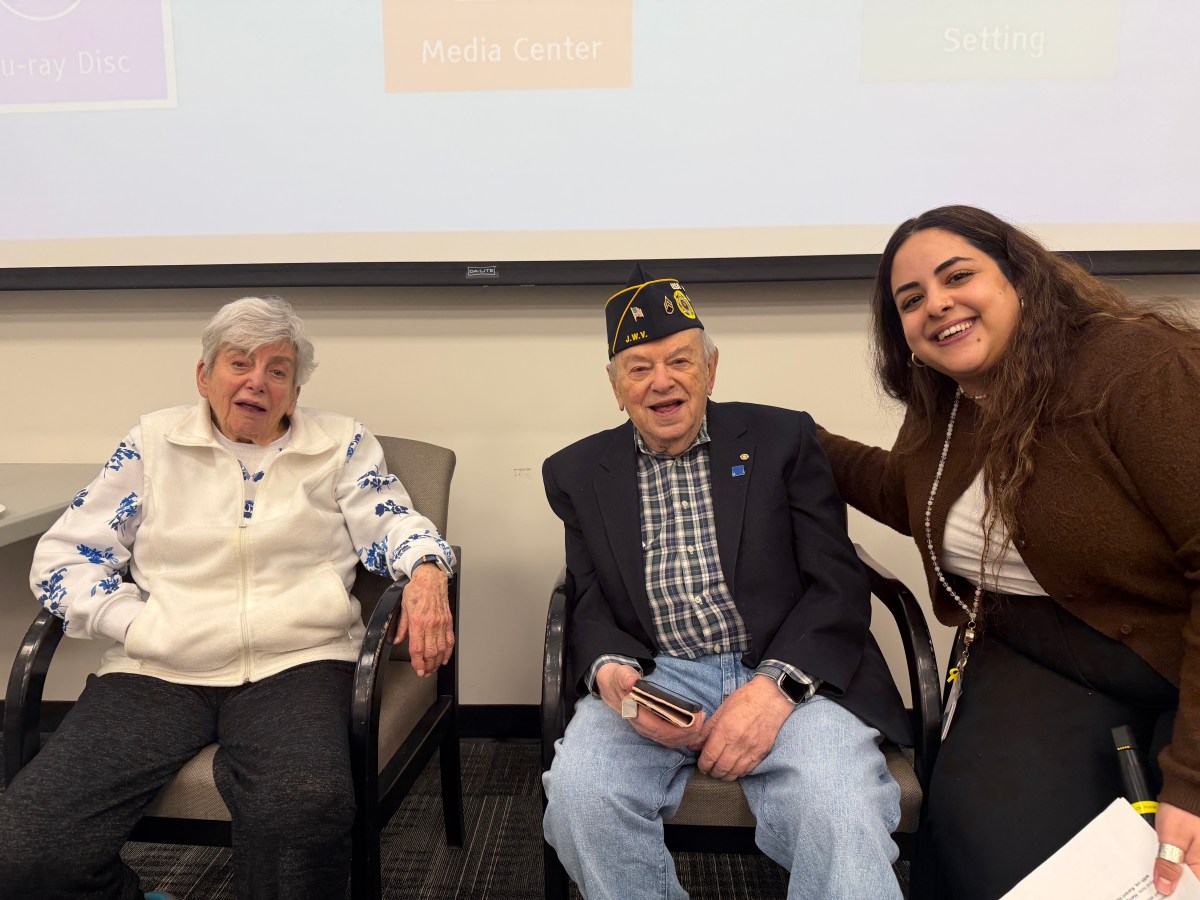
In a quiet room at Sid Jacobson JCC, members of the Long Island community gathered to honor International Holocaust Remembrance Day and bear witness to history through the firsthand accounts of Holocaust survivors Harry and Karin Arlin on Thursday, Jan. 29.
Observed annually on Jan. 27, the anniversary of the liberation of Auschwitz-Birkenau, International Holocaust Remembrance Day is a time to commemorate the six million Jews and millions of other victims murdered during the Holocaust as well as to reaffirm the importance of combating antisemitism and all forms of hatred today.
The event, part of the Zikaron BaSalon initiative, which translates from Hebrew as “remembrance in the living room,” offers a space for small, intimate gatherings where survivors can share their experiences and participants can engage in reflection and dialogue.
Shaked Zazon, Sid Jacobson JCC community shlicha, opened the program by stressing the importance of listening and remembering.
“Hearing testimony is not just learning history,” she said. “It is continuing the story, carrying it forward, and making sure the voices of those who suffered are never forgotten.”
Harry Arlin, 98, shared the harrowing journey that marked his early years in Czechoslovakia. Born in 1927, he grew up in a Jewish family living on the border of what became the Sudetenland after the Munich Agreement of 1938. His father, an accountant, sought ways to protect the family as the Nazis expanded their control. Using baptism certificates obtained through bribery, the family fled to Yugoslavia just before Adolf Hitler’s occupation, narrowly avoiding capture.
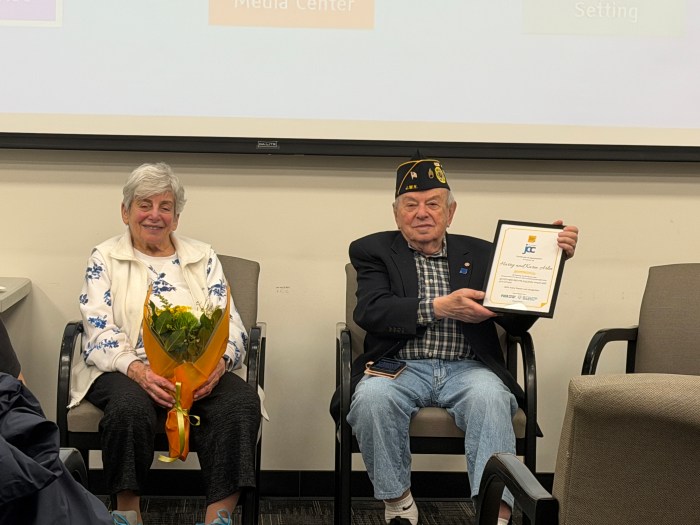
“When we were sent to a concentration camp in southern Italy, it was nothing like Auschwitz,” Arlin said. “We were treated humanely, our belongings were returned, and we could go swimming in the nearby river. But we were still prisoners, forced to leave home and live under constant uncertainty.”
After two years in the Italian camp, Arlin was liberated by the British Eighth Army. Fluent in six languages, including German, Czech, Italian, and English, he volunteered as a translator.
He later joined the Czechoslovak army and eventually made his way to the United States in 1946, reuniting with his parents in Astoria, Queens, after years apart.
Karin Arlin recounted her own perilous journey as a child fleeing Nazi Germany.
Born in Berlin in 1932, she and her family moved across Europe, including the Netherlands, Holland, and eventually Cuba, before arriving in the United States.
She recalled the fear and dislocation of leaving her home at a young age, and the small comforts she held onto, most notably a children’s book about a traveling bear that accompanied her through her journey.
“I felt like that little bear,” she said. “It was my companion on a big journey to a new world, and it reminded me that hope can travel with you even when everything else is uncertain.”
Throughout the evening, the Arlins emphasized the ongoing importance of remembrance in the face of rising antisemitism worldwide.
“It’s essential that the younger generation knows what we endured,” Harry said. “Remembering is our responsibility. ‘Never again’ is not just a slogan, it is a commitment.”
Attendees listened attentively as the couple described the challenges of displacement, rebuilding lives, and forging connections in new countries.
Some asked questions about what it meant to be a “prisoner” when they had done nothing wrong, and the Arlins explained that survival often meant gratitude for safety, even in constrained circumstances.
The gathering also highlighted the moral imperative of Holocaust education.
Zazon reminded attendees that memory is an active responsibility: “As the generation of Holocaust survivors continues to decrease, the choice to remember is not only about the past, it is a commitment to the future. It is an act of hope, morality, and repair.”
By sharing their stories in an intimate setting, the Arlins connected personal history to the broader lessons of resilience, courage and moral responsibility.
Their testimony offered not just historical facts, but the human context behind the numbers, reminding the community that behind the six million Jewish lives lost were fathers, mothers, sons and daughters.
In closing, attendees were encouraged to carry the responsibility of remembrance forward, ensuring that history remains alive and relevant. The Arlins’ presence and courage offered a tangible link to the past, reinforcing the power of personal narrative in shaping collective memory.
For those gathered, the evening was more than a commemoration. It was a call to witness, to engage and to bear the torch of memory so that the lessons of the Holocaust remain vivid and urgent for generations to come.