


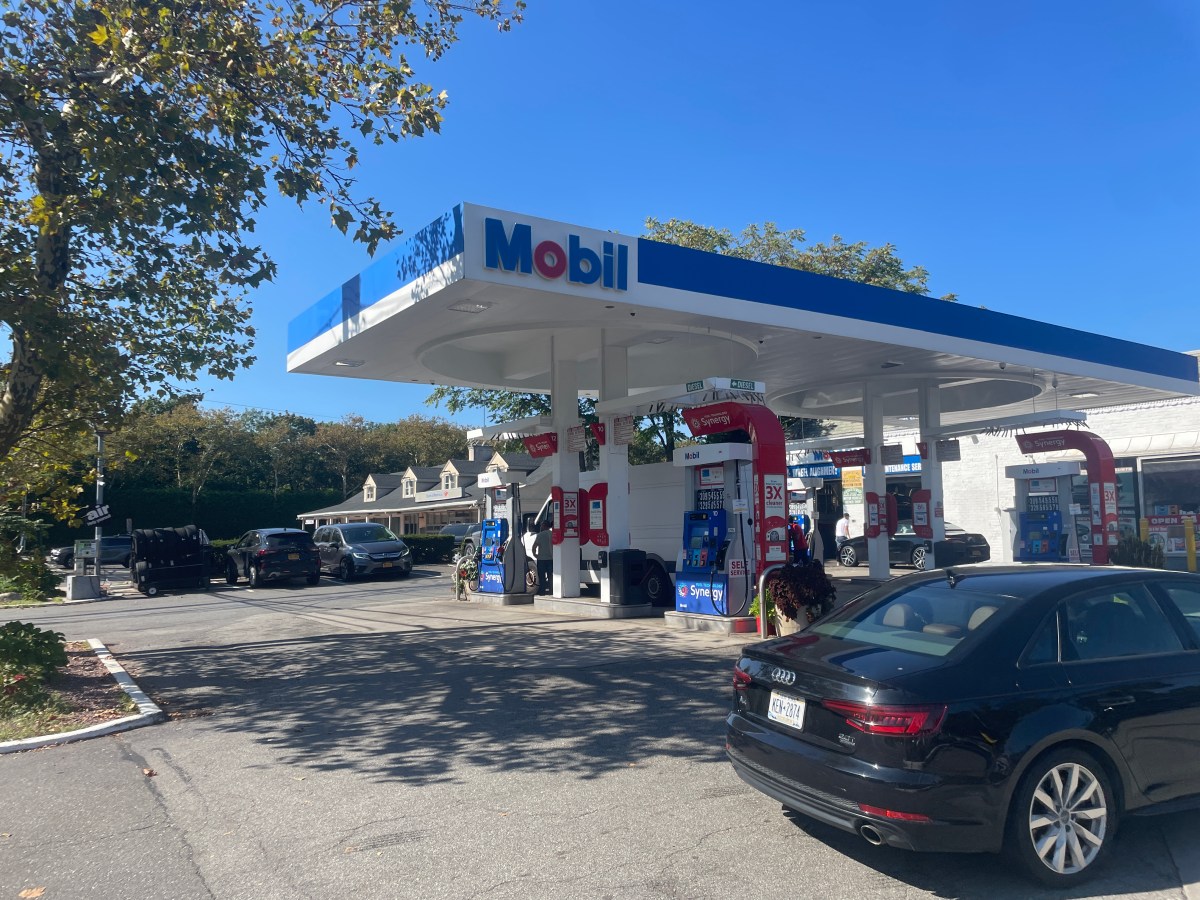
As the recent war on Iran extends past two weeks, gas prices have continued to rise across the country – and New York is no exception. According to the American Automobile Association, the state average price rose to $3.60 per gallon as of Sunday, March 15, a 70-cent increase since last month. Nassau and Suffolk area gas prices had to an average $3.55 per gallon, as of Thursday, March 12, a 75-cent increase since last month’s report.
This is slightly below the national average price, which is at $3.69 per gallon.
AAA attributes the rising gas prices to the ongoing crisis in the Middle East. On Feb. 28, the United States and the Israeli army began a massive military operation, dubbed Operation Epic Fury, against Iran in an effort to “defend the American people by eliminating imminent threats from the Iranian regime,” President Donald Trump said in a statement posted on Truth Social. Trump . He cited claims that Iran’s continued development of its nuclear program was the reasoning for the attack.
As a direct result, the narrow Strait of Hormuz has been effectively closed to oil tankers around the globe. The Strait of Homuz is one of the world’s busiest oil channels, connecting the Gulf of Oman to the Arabian Sea. Nearly 20% of the world’s oil passes through the channel, with 20 million barrels moving through the channel on a normal day. It connects crude oil from not just Iran, but other major Gulf states such as Iraq, Kuwait, Qatar, Saudi Arabia and the UAE. The current threat to the flow of oil is affecting the global gas cost, with the price for a barrel of crude hovering around $99-$101.
Before the Feb, 28 armed strikes against Iran from Israel and the United States, gas prices remained relatively low, with Nassau and Suffolk pump prices averaging $2.85 per gallon and the national average hovering at $3.08.
The crisis will seemingly continue. In his first public statement since being appointed Iran’s new supreme leader, Mojtaba Khamenei, announced Thursday that the closure of the Strait of Hormuz passage should continue as a “tool to pressure the enemy.” Khamenei was appointed after the assassination of his father, Ayatollah Ali Khamenei, who was the previous supreme leader.
As a result, the U.S. The Department of Energy announced the release of 172 million barrels of oil from the Strategic Petroleum Reserve to lessen the impact of energy costs.
“Rest assured, America’s energy security is as strong as ever,” said Secretary of Energy Chris Wright in a press release.
The release of oil from the reserve is a part of an agreement with 32 other countries in the International Energy Agency, which unanimously agreed to release a collective 400 million barrels of oil. It is expected to take about 120 days to deliver the oil.

This is not the first time the United States has dipped into the reserves in recent memory. In 2022 during Russia’s war on Ukraine, The Biden-Harris administration released 180 million barrels of oil from the reserve over a six-month period – resulting in the largest sale from the reserve in U.S. history. The emergency stash has yet to be completely restocked, with efforts from both the Biden and Trump administrations stalling from lack of funding from Congress.
In the past, New York has strategically allocated tax breaks to alleviate the hefty cost of energy. In 2022, after gas prices skyrocketed from the war in Ukraine, G0v. Kathy Hochul announced a gas-tax “holiday” that lasted from June 1, 2022, through Dec. 31, 2022.
The relief, suspending a total of 16 cents per gallon in state taxes. Other New York Counties added additional caps. Nassau and Suffolk counties only collected tax on the first $3 charged per gallon of gas and diesel.
However, Hochul told a reporter on Wednesday in a Q+A session hosted by Politico that she would not rule out instituting another tax break, but would prefer that the federal government take on the burden of relief.
“I’m going to look at all the plans we have to possibly reduce it, but what we could use is a federal excise,” Hochul said.
Hochul expressed hesitation about the tax holiday, citing that the previous 2022 holiday was not actually beneficial to New Yorkers.
“I don’t think even people felt it because you know what happened? The price just went even higher,” Hochul said.
A 2022 analysis by the Institute on Taxation and Economic Policy confirmed Hochul’s doubts. The analysis, which was prepared for the new site New York Focus, discovered that less than 50 cents went back into the pockets of New York Drivers for every dollar the policy ended up costing the state.