



Three students from Herricks Public Schools raised accessibility concerns and requested American Sign Language classes as well as better support for individualized education plans in classes at the school board’s Wednesday, March 18, meeting.
Faris Katel, an eighth-grader at Herricks Middle School said the accommodations and support he needs through his Individualized Education Program are not provided in his world language classes.
“In my Spanish class, there is no access to the type of support that I need when learning material and engaging in the culture of the program,” he said, adding that the class has 27 students and one teacher. “The pace of the class can be difficult to keep up with. If there were another educator in the class, I would be able to keep up with my peers and not feel as if I was falling behind.”
Board President Juleigh Chin thanked the students and parents for sharing their concerns.
Superintendent Tony Sinanis said since world languages are not a core state requirement for graduation, they are often not included in co-teaching programs.
He said many districts, therefore, grapple with the desire to provide access to co-teaching and the need to balance budgets based on requirements. He said the district can look forward to other ways to support students that may not include co-teaching models.
Vincent Gentile, an eighth-grader who said he has learning difficulties from dyslexia, dysgraphia, and attention deficit disorder, said world language classes are extra difficult.
“If I could learn Sign Language, it would help other students and me like me to feel included in learning a language,” he said. “My classmates and I feel like we are left out, and we would like to feel supported when we learn.”
Sinanis said he has discussed introducing American Sign Language courses with former language department leadership, but that given the increased prevalence of Cochlear Implants and other factors, it has not yet been implemented.
“That’s not to say that it’s an important language and an important form of communication,” he said.
“We can certainly engage in a conversation with Special Ed. to see where those things may be feasible,” Liz Guercin said, adding that they might consider identifying a cohort of students for increased support or creating a threshold of student numbers at which increased support could be implemented.
She and Sinanis said they could increase attention to the issue, and thanked the students for raising concerns.
A parent who requested anonymity due to her employment said her two children have language-based disabilities, and added that the support in core classes is great, but in world languages, it is lacking. She said the primary pathway for helping students has been exemptions, but there should be more options, such as co-teaching.
“Foreign language classes carry the same level of rigor and academic demand in this district as other subjects, yet unlike those classes, they are not supported by a special education teacher,” she said. “For students with language-based disabilities, this creates a significant barrier.”
She said implementing co-teaching would increase the potential for success for special education students, and adding an American Sign Language curriculum would provide more accessible language options for all students.
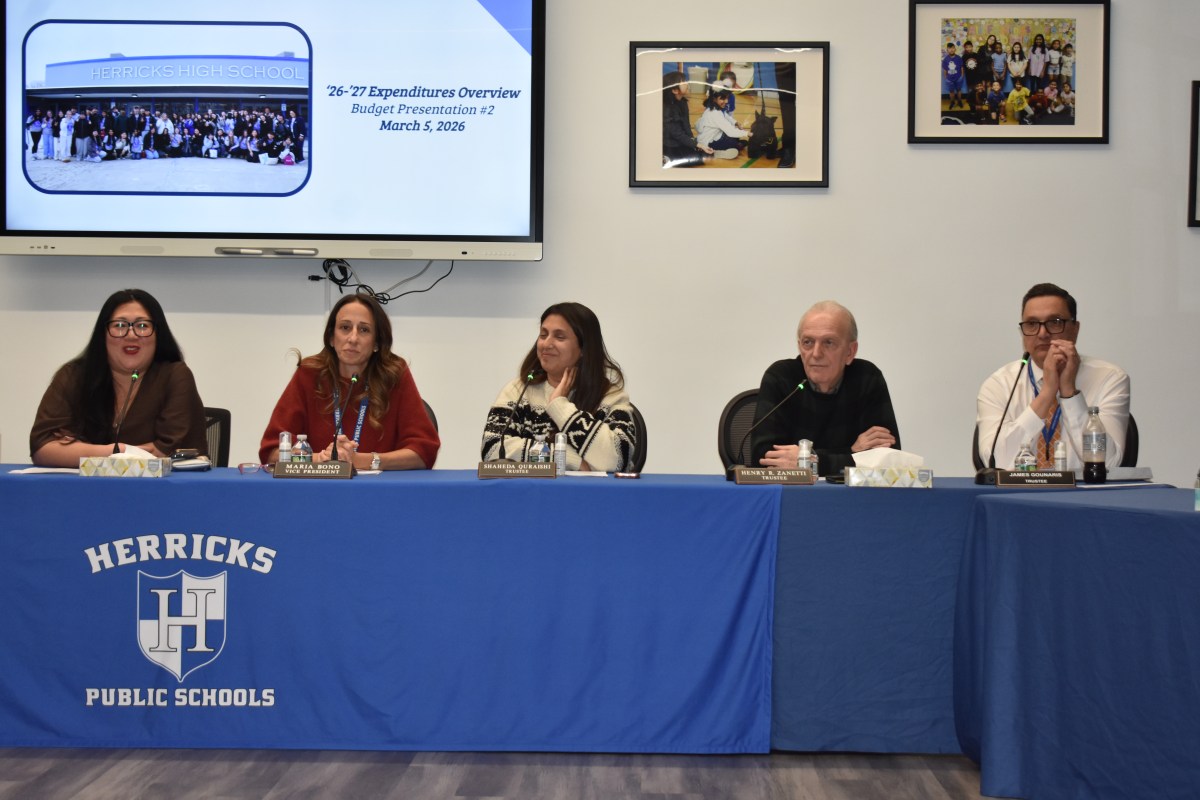
At the meeting, district administrators gave the third budget presentation, focusing on projected revenue for the 2026/2027 school year. The presentation said the total projected revenue for the proposed budget is $149,312,913, a $4,769,703 (3.3%) increase over last year.
Assistant Superintendent for Business Lisa Rutkoske said 75% of revenue comes from property taxes, which is a 2.12% increase over last year’s tax levy. According to the presentation, the increase is below the allowable tax levy limit of 2.3%.
She said that 20% of the district’s revenue is likely to come from the state budget proposed by Gov. Kathy Hochul, but not yet approved by the state Legislature. According to the presentation, projections show an 8% increase in state aid under Hochul’s executive budget proposal.
According to the presentation, the projected increase in revenue from state aid is $2,235,405, an 8% increase over last year.
Rutkoske said the district is planning to appropriate $1.7 million from its current balance to help support next year.
She said the district has an unassigned fund balance each year, which the state mandates must remain at or below 4% of the following year’s total budget. Rutkoske said the district has exceeded the 4% limit twice recently, once due to COVID-19 and once last year because the district projected settlement payouts related to the Child Victims Act litigation.
Sinanis said at a previous meeting that the district has paid around $50 million in settlements. It has since authorized the district’s counsel to pursue litigation to recover funds from the insurance companies that represented the district at the time.
Rutkoske said the district is proposing ballot measures to use capital reserve funds, which as of June were around $2 million, to fix boilers in two district buildings and upgrade athletic field lights. The third ballot measure is to establish a new capital reserve of up to $9 million, according to the district.
The district’s budget vote will be held on May 19 at the Herricks Community Center.