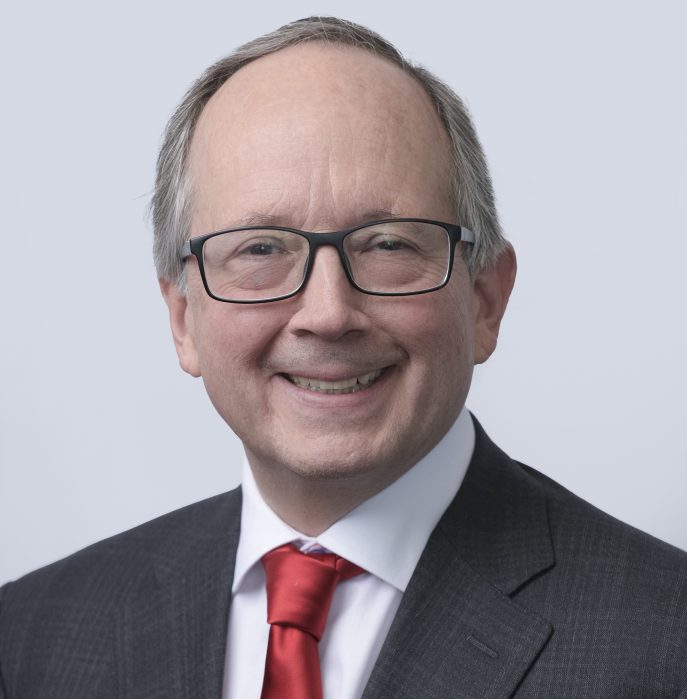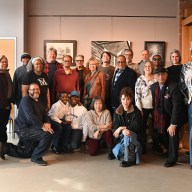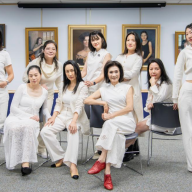



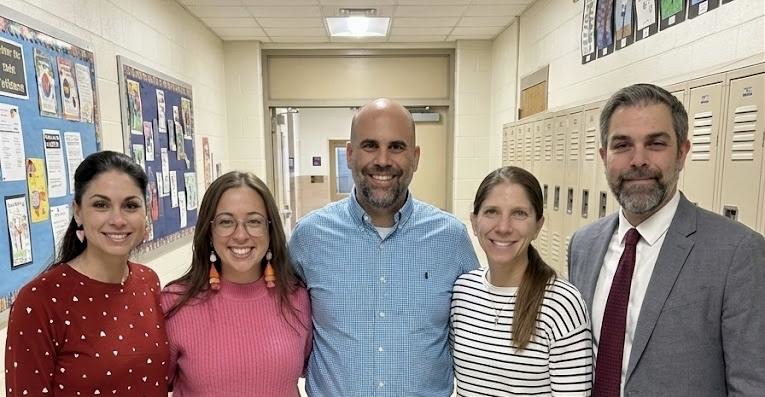
“What do the rapid changes wrought by AI mean for our art students?” inquired Christopher Hale, Syosset High School’s director of fine & performing arts, in his introduction to the presentation of “Process and Authenticity” by four Syosset visual arts educators at the board of education’s meeting on Monday, Feb. 9.
The educators framed their discussion around the way these “two pillars of the visual arts experience” shape their approach to art education in Syosset. The presentation offered a timely, humane and reflective response to the encroachment of artificial intelligence in the arts, particularly AI’s ability to create images and graphic designs in seconds.
“When we look back in 20 years, what skills, competencies, and habits will truly matter for our students?” Hale said.
The goal of the process and authenticity approach, Hale said, is to help students “develop habits of mind, develop their voice, go deep into sustained investigations and in a truly authentic way examine the human experience.”
Mariana Beach from Walt Whitman Elementary School opened the presentation with “Process: The Habits of Mind.”
She described how primary school students develop foundational skills, focusing on materials and how they work. Students establish routines and gain experience in as many artistic disciplines as possible. As they grow into the middle grades, the emphasis shifts into understanding their authentic selves as artists, Beach explained. Students are discovering their personal styles and preferences, and begin focusing on process and exploration of ideas.
“By providing our students with an arsenal of choices, we are allowing for more agency on their part,” Beach said. “The work created becomes more authentic to who they become as artists.”
Amanda O’Rourke, an arts educator at Syosset Middle School, followed with a discussion of “Developing Voice and Social Awareness.” As middle school students transition from concrete to abstract thinking, and begin to question their identities, the art world offers a unique opportunity for exploration, she said.
“Art becomes a tool for advocacy, empathy, and community-building,” O’Rourke said. “Students have agency over their artistic creations, and in turn, discover how their artistic process gives them a voice.”
O’Rourke described how she drew inspiration for a student project from the NFL’s “My Cause My Cleats” annual campaign, which raises awareness for various charities. Students have full agency to select a cause that resonates personally, leading to higher engagement and emotional investment in the artwork, she said.
“The My Cause prompt acted as a lens revealing the diverse backgrounds of the student body,” she said. “The project spanned heritage and nationality, health and wellness, faith and religion, the arts, athletics and civic interests.”
In this way, “Art becomes a vehicle for a cross-cultural dialogue,” O’Rourke said.
Next, Tiffany Holtje, an AP art teacher at Syosset High School, took up “Processes of Sustained Investigation.” She discussed how—mirroring the College Boards’ transition—the art program has shifted its focus from finished product to artistic process.
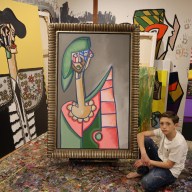
With the new approach, students complete “a sustained investigation” by creating 15-piece art portfolios that explore a specific theme, accompanied by written reflections on their artistic process. She showed an example of a student’s work on the inquiry, ”How can I visually explore climate change and humanity’s role in it?”
“In addition to polished pieces, we’re looking for an active reflection on why they’re making the pieces they are,” Holtje said. “Having students reflect on their process and articulate their creative choices helps make their work more insightful and more impactful.”
Damon Tommolino, an arts educator at Syosset High School, finished the presentation with “Examining the Human Experience through AP Art History.” Through the study of art history, his students explore such existential questions as, “Who are we? Where are we? Where are we going as a species?” Tommolino said.
Students analyze similarities and differences between artworks, using period, regional, historical, and process analysis, an approach which Tommolino described as “a merger of math, physics, and art history.”
“This course gives students a chance to have their own conversation through the artwork,” Tommolino said.
Hale concluded by highlighting the role of partnerships in Syosset’s art program, with organizations such as the Tilles Center Art Partner Program and PTA Curriculum Enrichment Program, and museum workshops at The Met, MoMA, Nassau County Art Museum, the Heckscher Museum, Penumbra Foundation, and Hofstra University Museum of Art.
Students are also encouraged to submit their work for exhibition. This academic year students have exhibited their art at a number of galleries and exhibitions, including Nassau County Juried HS exhibit, Atelier at Flowerfield Juried Exhibit, Huntington Arts Council, the Heckscher Museum’s “Long Island’s Best,” Art League of LI “Go Ape” Exhibit, Firefly Gallery of Northport’s “Kindred Spirits,” NYSATA’s “Art in Heart,” NYSED’s MLK Jr. Portrait Contest, Shanti Fund, and Cornell Cooperative Extension Calendar.
In addition, the Syosset High School Art Gallery continues to celebrate both professional and student art year-round.
“Our students are not only creating beautiful art, but are engaged in deep learning centered around process and authenticity,” Hale said. “We are not only creating artists, but infusing our students with deep knowledge and habits of mind that will enable them to thrive in both a future we imagine and one they envision.”
Superintendent of Schools for the Syosset Central School District, Thomas Rogers, thanked the presenters, saying, “This has been a very exciting way to engage with thinking about a broader question for us. I think this conversation about valuing process over product is going to permeate a lot of what we’re going to be doing in the next several years in the district.”