



The North Shore Board of Education reviewed sections of the district’s proposed 2025-26 budget, with trustees focusing on student programming, special education costs, transportation and technology during the Thursday, March 12, meeting, as they prepare to finalize a spending plan for voters this spring.
The board announced an initial $129 million budget proposal for the 2026-2027 school year, a 2.9% increase from the approved 2025-2026 budget. The budget proposal includes a 2.3% increase in the tax levy.
District officials said the budget is still evolving as the board works through line items and gathers community input before adopting the final proposal in April.
“We’ll have a series of pre-adoption budget meetings over the next several weeks,” Superintendent Chris Zublionis said during the meeting. “These are meetings where we’ll get input from the community about the decisions that the board is currently considering before they adopt the budget that the community will vote on.”
The superintendent said the discussion centered largely on student programming, which he described as the core of the district’s spending priorities.
“The student programming, the student experience, is really the heart of tonight’s discussion,” he said.
A community meeting focused on district programming is scheduled for March 18, followed by two budget forums on March 23 and April 13. The board plans to adopt the proposed budget on April 16 before it goes to voters in May.
Those sessions will focus on how the budget is structured, including revenues and expenses, while also allowing residents to discuss programs that may be affected.
One area highlighted during the review was special education, where administrators said enrollment and costs continue to grow.
District officials said about 19% of students are currently classified as needing special education services, and the number is expected to gradually increase.
“They continue to increase,” Zublionis said when asked about the trend in special education enrollment.
Zublionis said that special education costs can fluctuate significantly depending on the needs of individual students, particularly when out-of-district placements are required.
“You could have a big increase in one year that drives that number,” Zublionis said, noting that tuition for a single specialized placement can reach about $80,000.
Transportation costs can also rise when students must be bused to programs outside the district.
Trustees also discussed transportation spending and the state’s requirement that all school buses transition to zero-emission vehicles by 2035.
The district currently plans to purchase several new buses as part of its capital replacement cycle, including two large buses and four smaller ones.
Some trustees expressed concern about investing in diesel buses while the state mandate remains in place, but administrators said the district has flexibility through waivers and studies currently underway.
“We are actually able now to buy buses through the end of 2029 with our current waiver,” said James Pappas, assistant superintendent for business, adding that the district is conducting a needs assessment on how to transition to electric buses.
Board members also noted that North Shore’s decision to operate its own transportation system has helped control costs over the years.
The district’s transportation center, built in 2007, helped the district avoid major price increases during recent driver shortages and fuel spikes, Board President Andrea Macari said.
Technology spending also drew discussion, particularly the district’s one-to-one Chromebook program and whether older students might benefit from more powerful devices.
Trustee Lisa Cashman said it may be worth exploring stronger devices for upperclassmen as technology needs evolve.
“It would be great to really try and find something more robust for the high school,” Cashman said.
Board members noted that many students already bring personal laptops to school, raising concerns about equity between families who can afford upgraded devices and those who cannot.
“To that point, it becomes an equity issue,” Cashman said.
During the student representative’s report, students raised concerns about Wi-Fi connectivity and access to online educational videos such as those hosted on YouTube.
“I know a lot of teachers still try and use YouTube to play educational videos in the classrooms,” the student representative said, adding that such videos can help students better understand concepts in subjects like science.
Administrators said the district would investigate the issue, noting that some restrictions stem from Google security settings affecting school networks.
During public comment, a Sea Cliff parent spoke in support of allowing high school-level courses taken in middle school to count toward a student’s GPA.
“If we’re entrusting them with that rigor … then it goes without saying it should also appear on their high school transcript,” the parent said.
The parent also argued that the current policy could create inequities if the same course counts toward a GPA for some students but not others depending on when they take it.
The meeting also included recognition of several student achievements and district updates.
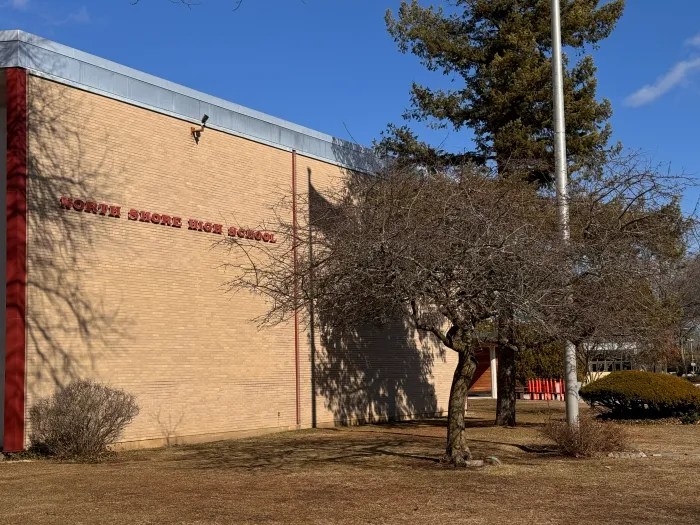
Officials congratulated members of the North Shore High School winter track team for winning the New York State Class 2 championship in the 4×800-meter relay — the first relay state title in school history.
Administrators also said registration for the district’s universal pre-kindergarten program has been completed, with the lottery scheduled for the week of March 23.
The board will continue reviewing the proposed budget over the coming weeks before adopting a final version in April.