



As 1 in 5 Long Islanders struggle with mental health challenges and more than 1 in 6 people aged 12 and over face substance use disorders, the need for treatment is greater than ever.
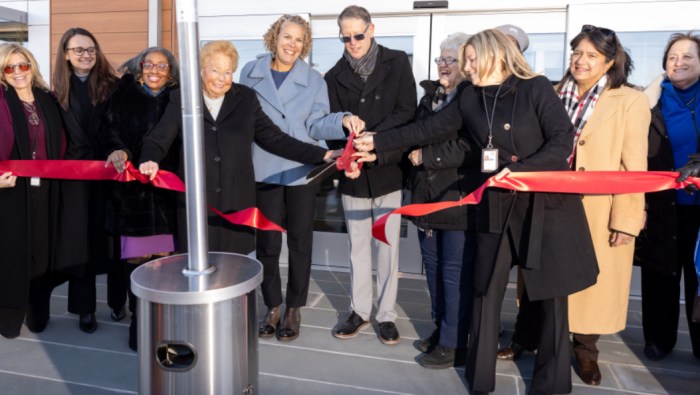
To meet that need and continue its longstanding commitment to serve Long Islanders, CN Guidance & Counseling Services (CN Guidance) has just opened a new 24/7 Community Crisis Center (CCC) alongside its Certified Community Behavioral Health Clinic in Hicksville. The new center provides round-the-clock walk-in mental health and substance use crisis stabilization services for adults, children and families to help turn the tide of opioid overdose epidemic and the youth mental health crisis.
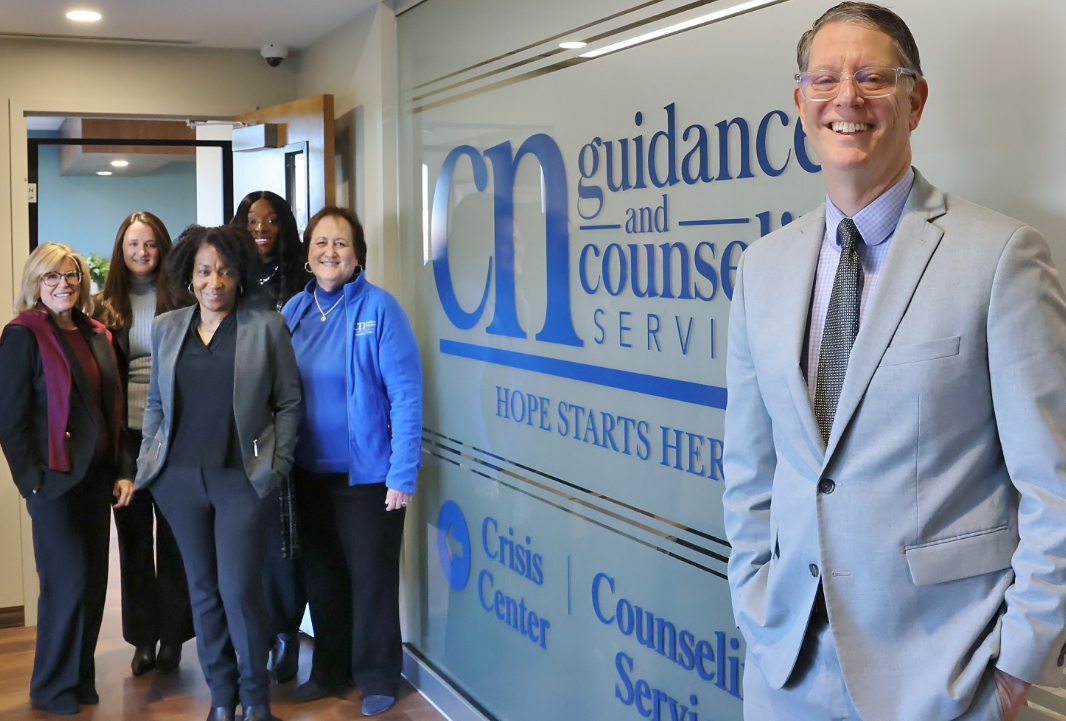
“We anticipate that once the word is out, we’ll be seeing about 20 people a day who come through the facility. They can stay 23 hours and 59 minutes and then be given a referral to their long-term treatment,” says CN Guidance CEO Jeffrey Friedman, adding that most folks won’t need to stay the maximum allotted time and people will largely be steadily coming in and out of the facility.
Expanding to Meet the Need
Over its 50+ years in operation, CN Guidance has grown into a leading and innovative provider of mental health and substance use treatment on Long Island.
When Friedman took over as CEO 12 years ago, the organization had 150 employees and reached approximately 3,000 people. Today, the agency boasts 450 employees and reaches over 20,000 lives a year: spanning from the Queens/Nassau border out to Riverhead.
“It has been exciting to be part of an agency that has such an innovative spirit and really puts community services first,” Friedman says. “We have a very dedicated staff and board of directors who always think of our community first. And what’s really exciting is in 2026, we’re going to be expanding our services into Queens.”
The agency’s continual growth is due to its success at securing funding to meet the growing need for services for the local populace, which, to this day, suffers more from anxiety, depression, and isolation due to the COVID-19 pandemic.
“It’s been very hard to watch people have their coping skills deteriorate and have their mental health and substance use challenges really hamper them living a productive life,” Friedman says.
Twelve years ago, the waiting list for mental health or substance use services was anywhere for 4 to 8 weeks, at which point the client would come in for an intake and be asked to return 3 weeks later for an appointment.
“We’ve gone from that to treatment on demand where now we can say, ‘Come to our facility today where you will be evaluated, observed and get treatment immediately.’ And when you leave, you will be given a direct referral for a personal appointment to start your long-term treatment,’” Friedman says.
Treatment can be either at CN Guidance’s appointment-based clinic or at a facility closer to the client’s home.
“We can connect them to a place that’s geographically or medically a better fit for them and make that referral,” Friedman says. “We have dozens and dozens of community partnerships where we have relationships where we can get people into treatment.”
Innovative Person-Center Treatment
At CN Guidance, the goal is to meet people where they are. Some come to the agency to receive treatment; for others, getting there may be impractical or impossible, presenting a barrier to care. Delays in care can translate into greater personal difficulties for individuals which can result in greater future costs to the community or system.
To reach people who lack adequate transportation to visit the agency’s clinic, the organization deploys two mobile recovery units that go into the field every day and provide substance use and mental health treatment in the community. Partnering with civic organizations, parks, probation, parole and other entities, the organization parks the mobile recovery units in the community where they do outreach and engage people in treatment.
“We know how hard it is to access care and what our organization does is to really look at those barriers and figure out ways to eliminate them,” Friedman says. “And I think we’ve done it very successfully and we continue to evolve as an organization to be able to connect people from all parts of our community.”
Rather than prescribing a one-size-fits-all program, CN Guidance tailors each treatment plan based around an individual’s needs.
“What might work for one person doesn’t work for another, and we’re able to customize our treatment for those individuals to ensure success,” Friedman says.
Urgent Care for People in Crisis
Despite greater societal awareness and openness around behavioral health, shame and stigma remain huge obstacles to care. “We want to normalize mental health and substance use treatment,” Friedman says. “We know after years of study in the field that it’s not just a character flaw to have a behavioral health issue. Rather, it’s a brain disease and it should be treated as such.”
CN Guidance’s Community Crisis Center endeavors to normalize treatment. “We’ve heard from so many of people over the years that when they went to the emergency room for a mental health issue, they were traumatized by the experience,” says Friedman, noting that children are often separated from their parents in an ER setting. “We’re trying to break those barriers and break that stigma and encourage people that having access to treatment is important and there’s nothing to be ashamed of when you get that treatment.”
Reducing the stigma of mental illness and substance use not only entails training and educating staff, but also the community at large, notes Jaclyn McCarthy, CN Guidance Vice President of Program Excellence.
The organization achieves this, McCarthy says, by taking part in community events and talking to people about these issues, explaining that “help is available and just because somebody is struggling with something today doesn’t mean that they can’t have a beautiful and fulfilling life.”
“By getting that information out there, by building those networks in the community, we have created an environment where people feel comfortable coming in or reaching out when they have started to experience something for the first time and they’re not really sure what to do,” McCarthy says.
The new community crisis center is an urgent care facility for someone who’s in crisis, adds Friedman.
“You can come at any time you’re in crisis, and you can get the help you need,” Friedman says. “And I think that’s such an amazing attribute that our community now has. For the New York State Office of Mental Health and Nassau County, specifically Nassau County opioid funds, to invest in this facility is a testament to not just one organization doing this: This is a community entity that is an incredible resource for everyone, no matter what part of the community you’re from, to be able to utilize. We’re very proud of that. We’re very proud that we’ve been entrusted to start such an important project.”
CN Guidance is located at 950 South Oyster Bay Road in Hicksville; 516-822-6111. For more information, go to cnguidance.org