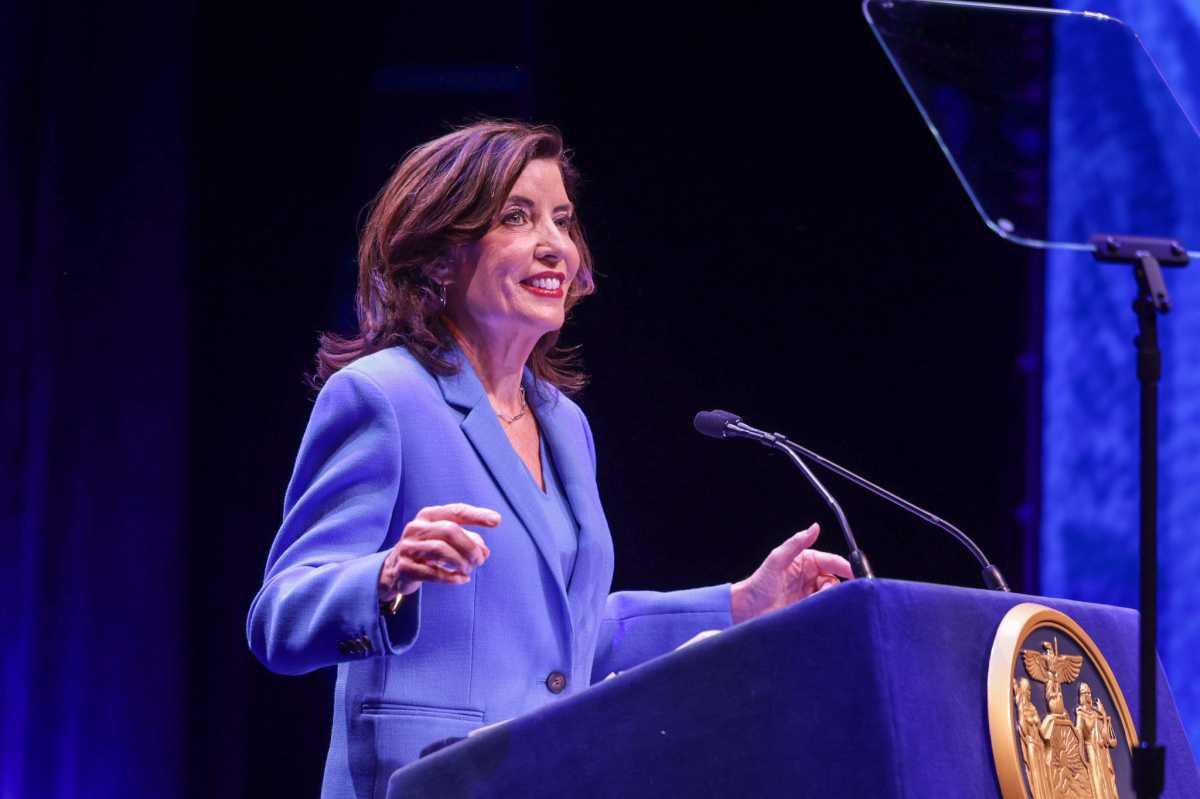





Gov. Kathy Hochul rolled out a 2026 agenda with major implications for Long Island, proposing new investments to combat coastal erosion, a long-awaited redesign of Jamaica Station, expanded education initiatives and sweeping changes aimed at lowering auto insurance costs.
In her State of the State address, the Democratic governor cast the proposals as a response to climate threats along Long Island’s coastline, mounting affordability pressures for suburban commuters and families, and what she described as aggressive federal immigration enforcement.
Details on how Hochul plans to pay for the initiatives will be released next week as part of her executive budget proposal, she said.
Hochul said her administration will expand investments to protect Long Island and other coastal regions from erosion, flooding and storm surge driven by climate change. The plan calls for a new round of state grants to local governments to strengthen shorelines and protect critical infrastructure, with an emphasis on nature-based solutions such as restored wetlands and “living shorelines” that absorb storm impacts.
The proposal builds on earlier state investments in flood mitigation and water infrastructure and is intended to help coastal communities adapt to sea-level rise while preserving access to working waterfronts and natural resources.
Hochul also announced plans to advance legislation that would allow New Yorkers to bring state civil lawsuits against federal officers who violate constitutional rights. The proposal comes amid what the governor described as aggressive federal immigration enforcement actions that have alarmed communities across the state.
“Power does not justify abuse,” Hochul said during the State of the State address. “And if someone’s constitutional rights are violated here in the State of New York, I say they deserve their day in court.”
Under the plan, federal officers would be held to the same legal standards that already apply to state and local law enforcement, including qualified immunity protections. Hochul said the measure would provide accountability without interfering with public safety operations and would ensure New Yorkers have a legal path to seek redress when constitutional boundaries are crossed.
Hochul also unveiled plans to redesign Jamaica Station, one of the busiest transportation hubs in North America, as part of a $50 million effort to modernize the aging Long Island Rail Road complex.
More than 200,000 passengers and 1,000 trains pass through Jamaica Station each weekday, yet the facility has not undergone a major upgrade since 2003.
The redesign aims to ease crowding, improve traffic flow and create seamless connections between the LIRR, New York City subways and the AirTrain to JFK Airport. State officials said the overhaul is increasingly necessary following the 2023 opening of Grand Central Madison, which has led to more frequent transfers and longer waits at Jamaica.
Hochul said her education agenda will expand the state’s “Back to Basics” approach beyond reading to include math instruction.
“And that’s why, two years ago, I took on some strong interest, and insisted that we go back to basics, and how we teach our kids to read for the first time in 20 years,” Hochul said. “And we got rid of ineffective methods. We took on that fight, and we won.”
Her legislative agenda will include a “Back to Basics” math plan requiring the state Education Department to provide instructional best practices to school districts, along with guidance and resources to help teachers select and implement math curricula aligned with state standards. In New York, standards are set at the state level, while curriculum decisions, including how material is taught, are made locally.
Hochul is also calling on the State University of New York and City University of New York systems to create microcredentials in evidence-based math instruction to support teachers statewide.
Additionally, the governor plans to allocate targeted resources to the state’s highest-need districts that are lagging in the science of reading. That effort will include a three-year pilot program beginning in Rochester and Yonkers, pairing districts with state colleges or universities to provide in-service professional learning aligned with evidence-based reading instruction.
The proposals build on Hochul’s 2024 “Back to Basics” reading agenda, which focused on evidence-based literacy instruction, including phonics, boosted teacher training, required the Education Department to provide best practices for teaching reading in prekindergarten through third grade and directed districts to align curriculum, instructional strategies and professional development with research-backed methods.
New York Republican gubernatorial nominee and Nassau County Executive Bruce Blakeman pushed back on the governor’s proposals, saying that promises alone are not enough.
“Last year, the governor made affordability the centerpiece of her State of the State,” Blakeman said. “One year later, New York is even less affordable, less safe, and deeper in debt.”
Blakeman said Hochul has had years of control in Albany to deliver real results on affordability, energy costs, health care, child care, and public safety — and has fallen short on every front.
Hochul also targeted auto insurance costs, which she said are among the highest in the nation and a significant contributor to the state’s cost-of-living crisis. New York drivers pay an average of about $4,000 a year for coverage, roughly $1,500 more than the national average, Hochul said during her address.
Her proposal includes a broad package of reforms aimed at combating insurance fraud, tightening standards for non-economic damage awards, limiting payouts for drivers engaged in criminal behavior at the time of a crash and giving insurers more time to investigate suspected fraud. Hochul also said the state would require greater transparency from insurers about rate increases and explore discounts for drivers who opt into safe-driving monitoring programs, with privacy safeguards.
The governor said the changes are intended to ensure savings are passed on to consumers, not insurance companies, and to provide relief to families, small businesses and transit agencies burdened by rising premiums.
“There’s one thing I know: New Yorkers move forward, with strength and compassion side by side. There’s no challenge we can’t meet. No tyrant we can’t beat, no future we can’t build. So let’s build that future together…” Hochul said, closing out her 2026 State of the State address.