


In our past columns, we have featured Great Neck’s Persian-Jewish community, both Mashadi and Tehrani, many of whom came here, escaping the 1979 Iranian Revolution. We have also spotlighted the various Chinese, Korean and other Asian communities that live here.
Well, there is a new flock bringing a new vibe. Nu?
The steady and visible influx of Russians, Ukrainians, Bukharians, Georgians, and others from the former Soviet bloc. Some arrived here directly from abroad. Others came via Queens (Forest Hills/ Rego Park/Kew Gardens Hills), Brooklyn, or New Jersey after establishing a foothold in the U.S.
And while the “Russian” label is most often used to identify them, their reality is far more diverse. These are distinct groups with different languages, histories, and identities and together, like the ones before, they have reshaped Great Neck.
Mirroring earlier immigrants in creating local footholds, they have further cemented the undeniable– “O.G. Great Neck” is slowly disappearing, replaced by a tidal wave of “traditional” and “conservative” devotees. Do you chap?
Great Neck is in demand
Great Neck has always been a magnet for those who value education and stability above most else. The Great Neck school district remains one of the strongest draws anywhere on Long Island. For immigrant families, schools are not just a selling point. They mean upward mobility and the general mood of every Tiger Mom.
Bolstered by entrepreneurship and status-conscious real estate decisions, we seem to have perfected the formula for success.
Every town experiences friction during cultural turnover. It would be dishonest to pretend the changes here have been seamless. (As if!) As evidenced by local Facebook and Nextdoor chat groups, many older residents are absolutely devastated and disoriented.
Especially, when their favorite local hangout disappears, to be replaced by an “ethnic” or religious spot, or when their new neighbors have vastly different traditions than their own. Author’s Note: Pain is inevitable, suffering is optional.
Still, Great Neck forges ahead, as Great Neck does, in three time-tested steps. We absorb, adjust and repeat. (Optional fourth step: Kvetch) And if you zoom out, it makes sense. Great Neck has always been the land for people who want to build. The landscape changes — the languages, the accents, the restaurants — but the core desire remains the same, in three steps: a place where you can work hard, live safely, and provide your kids with a better future.
And so, the most recent “Eastern European” influx to the peninsula isn’t one single wave. The story isn’t new. It’s multiple overlapping migrations, a new set of traditions that is quickly becoming part of our collective identity. And guess what? There is a clear overlap among our different communities, a veritable Venn diagram. It’s not just the chai served from the samovar or the crispy rice (tahdig) at Toku, either.
“The Russians are coming, the Russian are coming…”
Since Y2K, Eastern European a/k/a “Russian” communities, like the Chinese community, have brought a distinct rhythm to Great Neck: new restaurants, markets, bakeries, medical offices, salons, tutoring services, and niche professional firms. Some of their businesses market and cater specifically to their own. Others seek assimilation as part of the wider community fabric. C’est la vie, y’alla.
Just like many Persian and Asian circles, “Russian” households generally bring an intensely family-centered culture: multi-generational living, grandparents playing a big role, and a tradition of investing heavily in children’s education. That shows up across the board in Great Neck’s tutoring culture, music lessons, competitive academics, and of course, parents’ high expectations. Again, concentric circles.
Ukrainians
In Great Neck, Ukrainians are often perceived as “Russian”, but if you ask, or dig deeper, they may share that they are from Ukraine, and came here as political refugees, due to severe religious persecution. Jewish communities from Kyiv, Odessa, Kharkiv, Dnipro, and Lviv are Russian–speaking but may also speak Ukrainian. While they share a Soviet history, they’re a more nationally dispersed community, with differing family/community customs, food traditions, music and community organizations.
Bukharian Jews: A distinct community shaping Great Neck
One of the most important demographic shifts across Great Neck (and increasingly into Roslyn) over the last 20 years has been the growth of the Bukharian Jewish community.
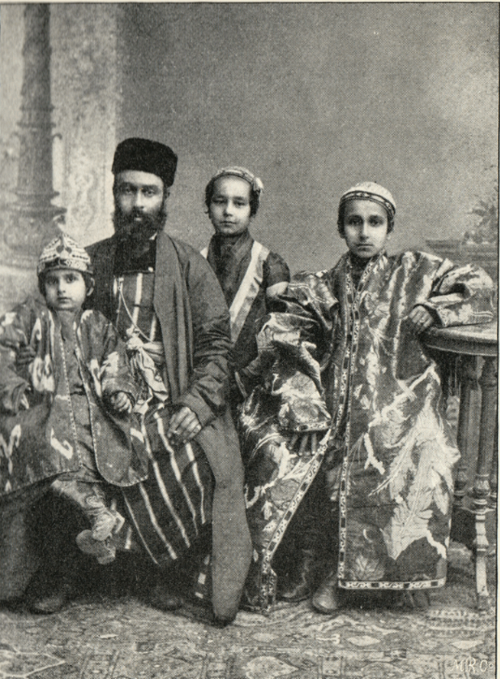
Like the Ukrainians, Bukharian Jews are also not “Russian Jews,” even though many families came through the former Soviet Union and may speak Russian. Some speak Bukharian, a Judeo-Persian/Tajik language. Bukharan Jews are one of the oldest Jewish diaspora groups, dating back to the Babylonian exile and comprise a branch of Persian-speaking Jewry. (Yet another connection)
Bukharian Jewish history stretches back centuries in Central Asia, particularly in places like Bukhara (in present-day Uzbekistan), Tajikistan, and surrounding regions.
In the New York metro area, many Bukharians built strong community centers in Queens (especially Forest Hills, Rego Park, and Kew Gardens Hills).
But over time, as the search for space and suburban stability intensified, more and more began moving east into Nassau County. Bukharian Jews in New York are known for their recognizable community identity and tight social networks. It follows that Great Neck’s main pillars: top schools, traditional family-centered life/ infrastructure, and upward mobility, hold great shared appeal for all of our sub-groups.
Bukharian Jews are frequently misunderstood by outsiders. (Experienced by many ethnic groups) To the unaware, they are perceived as “new Russians.” Others assume they’re Persian.
Bukharians are historically associated with the region of Bukhara, in what is now Uzbekistan, Tajikistan and nearby areas that were later absorbed into the Russian Empire and then the Soviet Union. So while many Bukharian families later lived under Soviet rule and often speak Russian, their deeper cultural background is less “Ukraine and Russia,” and more a mix of Central Asia, where languages, food, and traditions developed along centuries of Eurasian exchange.
Who knew —Great Neck is a modern-day Silk Road, evoking the vast network of ancient trade routes that connected China to Central Asia, the Middle East, and Europe.
It’s undeniable that today, Great Neck’s demographics are heavily influenced by cultures of the Middle East, Far East, Central Asia, Northern Africa, and environs. Geopolitically, there is great turmoil and instability, there, in our respective ancient homelands. Not coincidentally, our residents are seeking to realize the American Dream here in the Great Neck melting pot, safely and soundly. May we share good news soon?
Janet Nina Esagoff, a serial entrepreneur, founded Destination: Great Neck Ltd. in 2021 to strengthen and celebrate our town. Follow @greatneckbiz. Janet launched Esagoff Law Group PC in 2017, now located “in town” on Middle Neck Road. Prior to her law career, Janet designed special–occasion wear for girls and teens at Party Girl, her Bond Street boutique.