


The passing of Rev. Jesse L. Jackson Sr. marks the end of a monumental era in American civic and political life. For more than half a century, he stood at the forefront of the struggle for justice, inclusion, and democratic participation. He was not only one of the most prolific and passionate civil rights leaders of our time; he was a strategist, a coalition builder, and a moral voice whose resonance extended far beyond the pulpit.
Rev. Jackson understood something fundamental about American democracy: participation is power. Through the founding of the Rainbow PUSH Coalition he transformed protest into organized political engagement. He registered millions of voters, mobilized young people, galvanized ethnic minorities, and built cross-racial coalitions that reshaped the national political landscape.
His presidential campaigns in 1984 and 1988 were historic not merely because he ran, but because of what those campaigns accomplished. They expanded the electorate, brought marginalized communities into the political process, and normalized African American presidential viability on the national stage. The modern multiracial coalition that defines today’s Democratic Party carries his imprint.
Rev. Jackson’s leadership was anchored in moral clarity. He spoke with compassion, but also with conviction. His oratory blended the cadence of faith with the urgency of civic action. He challenged America to live up to its founding ideals, insisting that justice and equality were not abstract principles but obligations.
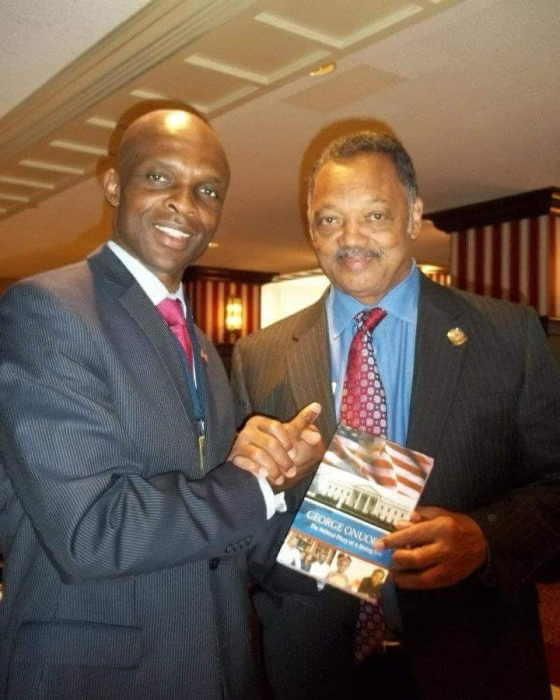
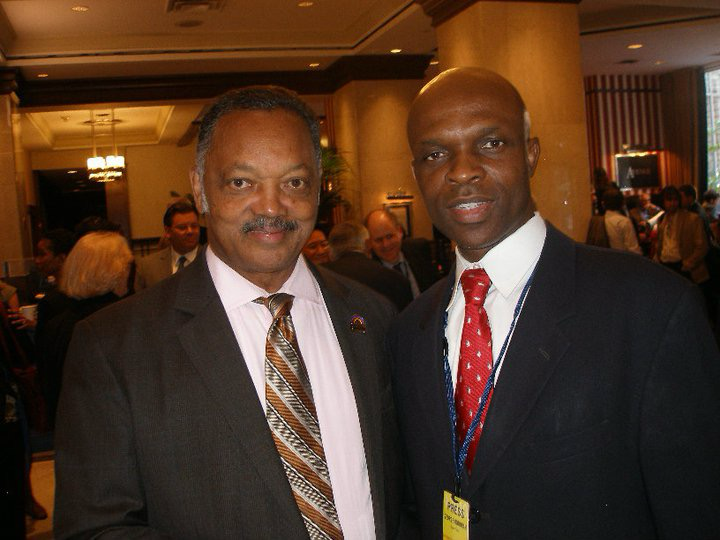
I had the distinct privilege of meeting Rev. Jackson during a Rainbow PUSH Coalition Summit in New York City. On that occasion, I interviewed him and witnessed firsthand the disciplined intellect and strategic focus that undergirded his public persona. At a later time, I presented him with a copy of my book, The Political Diary of A Rising Son (2010). That exchange remains one of the most meaningful experiences of my professional and civic journey.
The accompanying photographs from those encounters capture more than personal memory. One reflects a formal presentation of my book to a man whose organizing work helped expand the architecture of American democracy. The other captures a collegial moment beside a leader whose influence shaped generations of public servants, activists, and elected officials.
For me, these moments symbolized generational continuity. As someone committed to civic engagement and public service, I have long regarded Rev. Jackson as both an inspiration and a benchmark. He demonstrated that moral authority must be paired with organizational discipline. He showed that coalition-building requires patience, persistence, and principle. Most importantly, he proved that expanding democracy is not a one-time achievement but an ongoing responsibility.
Rev. Jesse L. Jackson Sr. leaves behind an indelible legacy. His work helped elect transformative leaders, broaden political participation, and strengthen the voice of communities long excluded from power. His impact can be measured not only in speeches delivered or offices sought, but in voters registered, young people inspired, and institutions reshaped.
We may not witness another figure of his magnitude in our lifetime. But the true measure of his legacy will be found in whether we continue the work he so steadfastly advanced—building inclusive coalitions, engaging the next generation, and holding our nation accountable to its highest ideals.
His voice may be silent, but his call to conscience endures.
George C. Onuorah, author, community activist and humanitarian