



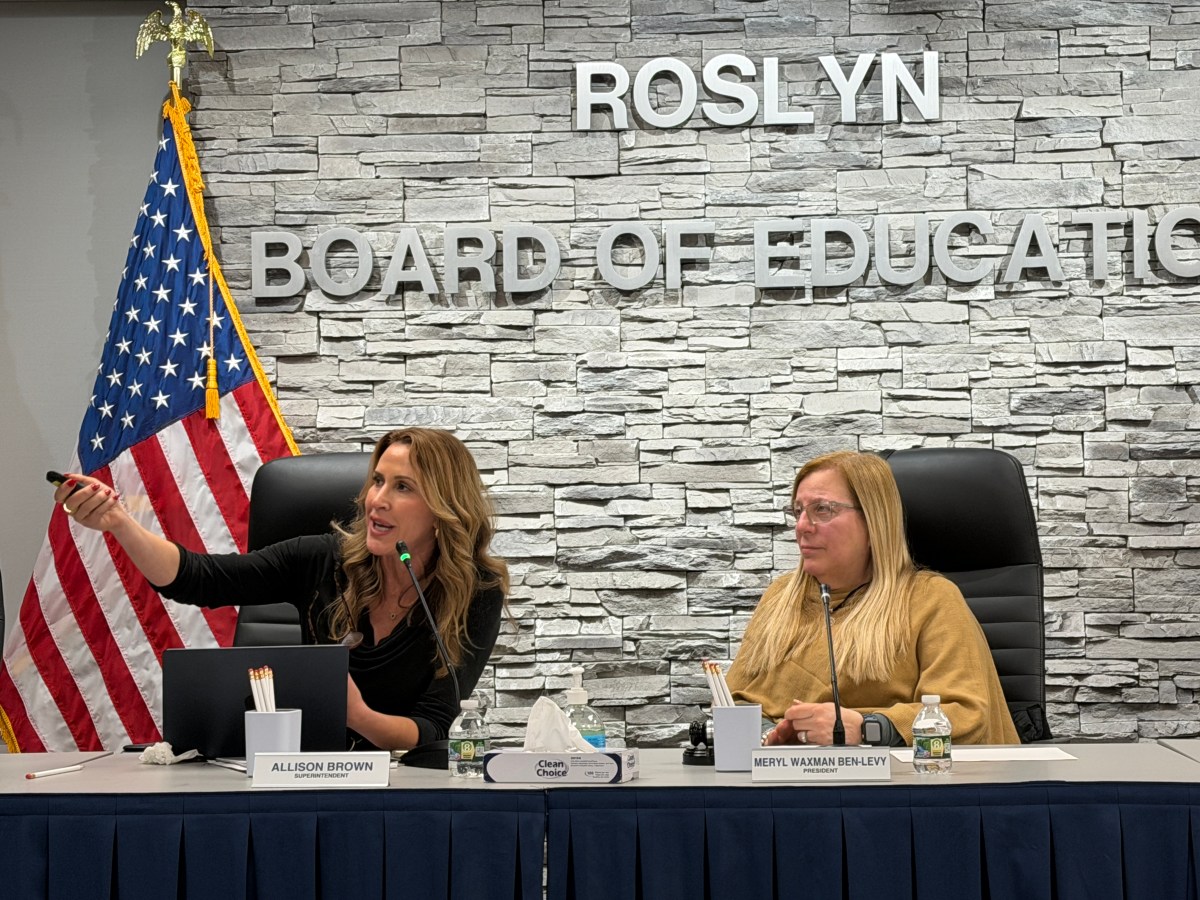
The Roslyn Union Free School District Board of Education received an update on the proposed 2026-’27 budget on Thursday, Feb. 26, as Superintendent Allison Brown outlined revenue projections and the ballot propositions voters will consider in May.
During the meeting, Brown presented a revised draft budget of $140,918,000, a 3% increase over the current year’s $136,811,323 spending plan for the district, which in the 2o24-2025 school year had 3,329 students. If unchanged, per-pupil spending would be $42,330 in the 2025-2026 school year based on calculations dividing spending by the student enrollment.
The proposal is down from the first draft unveiled in January, which totaled $142,184,616. The proposal carries a projected tax levy increase of 2.37%, just below the district’s 2.39% levy limit under the state tax cap formula.
The proposed levy of $112,331,592 represents a 2.37% increase, or $2,602,916, over the current year, according to district documents. Brown noted that the draft reflects adjustments from the initial January presentation, including a reduction tied to salary retiree breakage, an increase in expense-based state aid and a $1.8 million transfer to capital.
Brown said much of the growth in state aid is driven by reimbursement-based categories, including capital projects, transportation and BOCES services.
While foundation aid is slated to increase by at least 1%, reimbursement aid is projected to rise more sharply, with capital aid up 22.7% and transportation aid up 22.3% under the state’s executive budget proposal.
Despite the positive aid outlook, Brown cautioned that reimbursement rates can fluctuate based on state formulas and district spending patterns.
“We cannot assume aid will remain this high in future years,” Brown noted in her presentation, emphasizing the need for a fiscally conservative approach.
In addition to the budget, voters will consider several propositions at the May 19 annual budget vote and board election.
Proposition No. 3 would authorize the district to purchase school buses at a cost not to exceed $568,296, funded through bonds or installment purchase contracts.
Proposition No. 4 would allow the district to spend up to $3.5 million from the 2017 Capital Reserve Fund on renovations to classroom lighting and ceilings, and improvements to the high school parking lot.
Proposition No. 5 seeks to establish a new 2026 Capital Reserve Fund with a maximum amount of $45 million over 25 years. The fund would support future capital improvements districtwide, including classroom renovations, infrastructure upgrades, security enhancements and site work. The district would be authorized to transfer up to $6 million annually from surplus funds or other reserves to the new capital reserve.
The board also approved a resolution declaring proposed districtwide capital improvements as Type II actions under the State Environmental Quality Review Act, meaning no further environmental review is required.
The annual budget vote and election will be held on May 19.