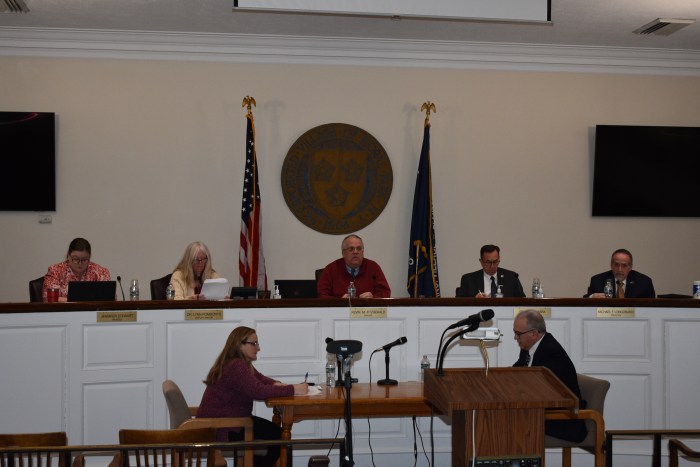




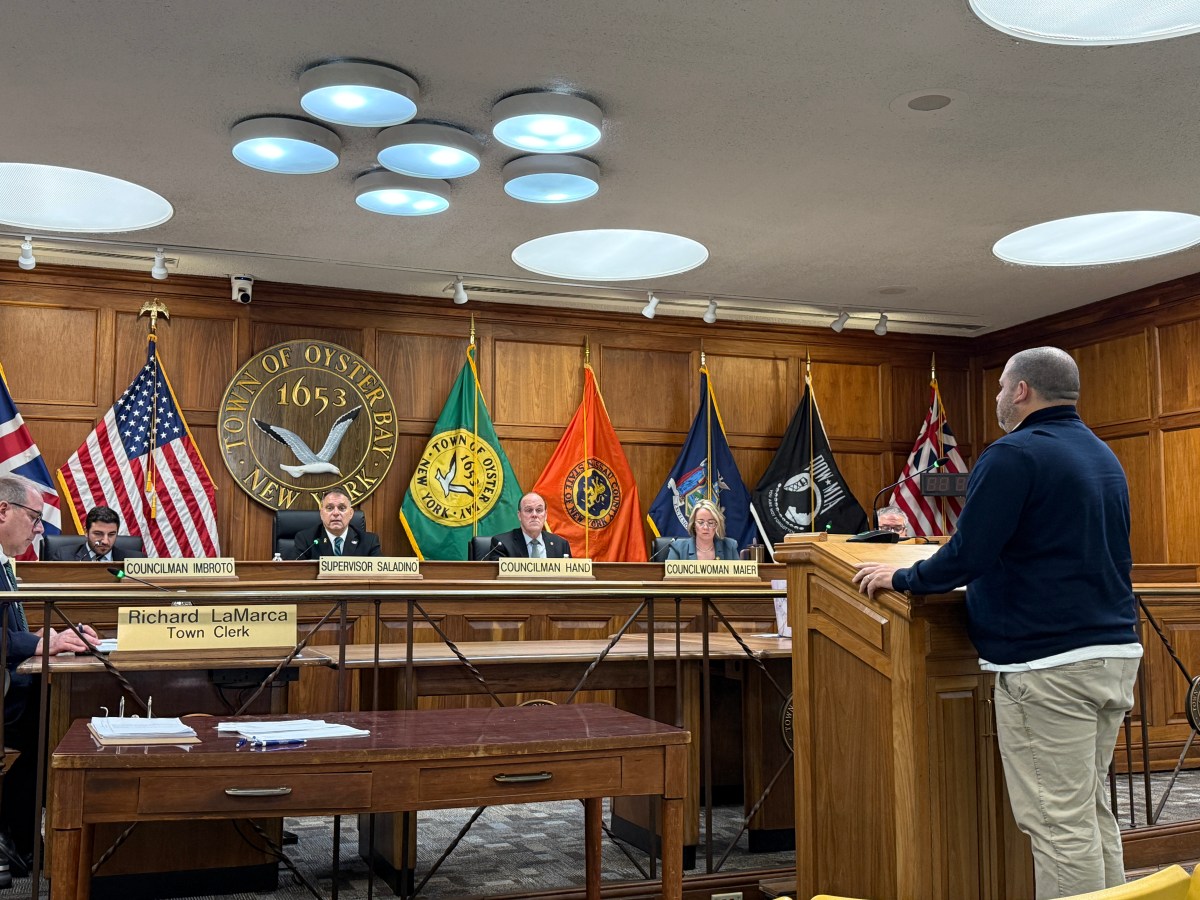
The Town of Oyster Bay adopted laws giving tax exemptions to spouses of police officers killed in the line of duty and disabled veterans and approved the issuance of over $5 million of bonds for capital programs.
Doug Larose, an assistant town attorney, presented the board with the two proposed laws, saying state law changes from late 2025 allowed the town the opportunity to consider making the change.
The two exemptions, which were both unanimously approved by the board, include providing a 100% tax exemption for disabled veterans and a 50% tax exemption for spouses of police officers killed in the line of duty.
Larose said conditions for a 50% tax exemption include that the spouse must be the sole owner of the property and that the property must be used for residential purposes.
“The main thrust here is to allow those surviving members of the family to continue to reside here in the Town of Oyster Bay, and for us to show how much we appreciate the ultimate sacrifice that the deceased’s spouse suffered,” he said.
Larose said that both exemptions solely apply to the town’s property taxes.
Town Supervisor Joseph Saladino said it is important to protect surviving spouses and that veterans are important to the town.
“We owe so much to their sacrifice,” he said.
Town Council Member Lou Imbroto also said he was “proud to sponsor this initiative.”
Rob DeRienzo, the town’s director of finance, said he was directed by local finance law to present the two bond issuances to the town board. The board approved a $1.4 million bond for the town’s park district and a $3.95 million bond for solid waste improvements, according to town documents.
He said both hearings are considered standard procedures and that the funding complies with the town’s financial plan.
“This will be another year where the town borrows less money than it pays down,” he said.
DeRienzo said the $1.4 million bond will go towards bathrooms, fences and walkways in parks, while the $3.95 million bond will be used for improvements to transfer stations, improvements to roads leading to transfer stations and other costs associated with solid waste improvements.
As part of the resolution calendar, the board also set a public hearing for its next meeting on Tuesday, Feb. 24, to consider extending the town’s moratorium on battery energy storage systems for an additional 12 months. The town has enacted temporary bans on the storage systems dating back to 2024, amid strong public opposition to the energy storage facilities.

The town held a hearing for the current moratorium in September 2025, extending the ban for six months.
The town board also honored several female organizations as part of Women’s History Month at the meeting.