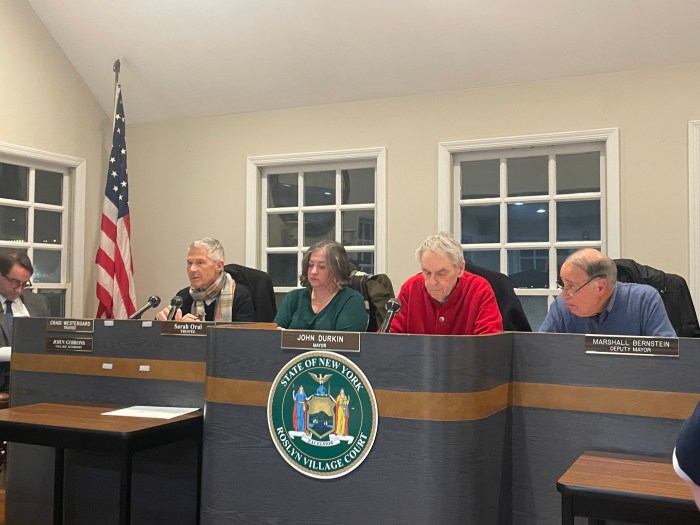





Frustration over development, zoning enforcement and transparency dominated the first public forum hosted by the Village of Manorhaven, as residents pressed village leaders Wednesday night to slow growth and prioritize neighborhood character over what they described as developer-driven projects.
The forum, held Jan. 7 at the Port Washington Adult Activities Center, was intended to gather community input on the creation of a comprehensive master plan for the village and followed the approval of a building moratorium in late August.
While village officials framed the meeting as a listening session, residents used the opportunity to voice deep concerns about overdevelopment, infrastructure strain and what several speakers called a lack of accountability.
The meeting began more than 30 minutes late and opened with visible tension.
Only Mayor John Popeleski and Deputy Mayor Harry Farina were present at the start, with Trustees Jeffrey Stone and Monica Ildefonso excused and Khristine Shahipour expected but not in attendance.
Several residents criticized the board for proceeding despite the absences, calling it unprofessional and emblematic of broader governance issues.
Once the public forum portion began, Popeleski emphasized that the village is embarking on a long-overdue planning process, noting that Manorhaven’s zoning map has not been fully updated since 1988.
He said the goal of the comprehensive plan is to create a long-term blueprint, spanning decades, that balances growth with preservation, and he stressed that resident input would be central to shaping the plan.
“Tonight is about hearing from you, what you want this village to look like for the next 50-plus years,” Popeleski said.
Village engineer Matt Ferraro of D&B Engineers and Architects presented what he described as a draft zoning map, explaining that it is not a proposal for new zoning changes but a comprehensive update reflecting existing conditions.
Ferraro said his firm reviewed decades of village resolutions, zoning amendments and town and county records to compile changes that were never formally incorporated into a single official map.
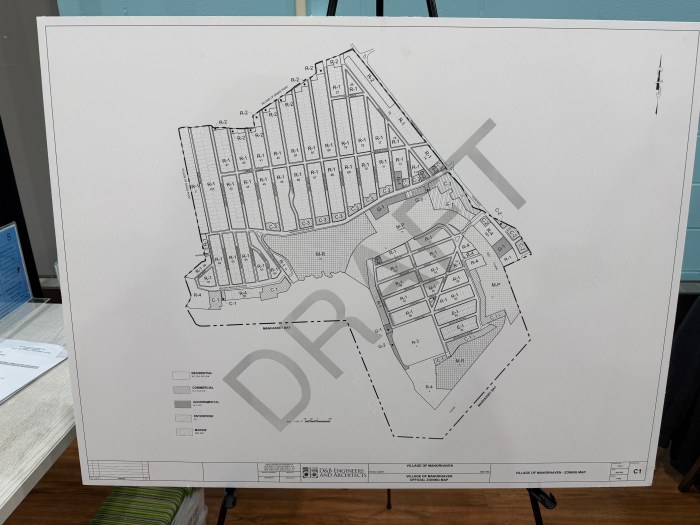
“This map shows where we are today,” Ferraro said, calling it a necessary first step in the planning process. He noted that discrepancies had emerged over the years, including zoning lines that no longer align with the shoreline and areas where boundaries extend into the water or fail to reflect past approvals.
0The draft map, he said, brings those inconsistencies to light and will serve as the baseline document for future planning decisions, though it has not yet been adopted into local law and must still be approved by the Board of Trustees and Nassau County.
Village attorney Christopher Neuman explained that a comprehensive plan serves as the foundation for zoning laws and future land-use decisions and typically takes years to complete.
Neuman acknowledged the cost of such a plan and said the village may forgo certain state grants to avoid conditions that could encourage higher density, such as accessory dwelling units. Neuman said the village will be taking on the expense of the plan. He said resident engagement would be critical at every stage.
Despite the pointed criticism, Popeleski said the village is committed to transparency and collaboration. He outlined proposals to create advisory committees for planning, business development and environmental issues, with members appointed by the mayor and trustees. Meetings, he said, would be held publicly at Village Hall.
Residents quickly made clear that development was their overriding concern.
Sherry Den, a Manorhaven resident, told the board she believes the village is being pushed in a direction dictated by developers rather than homeowners. While she said the community is not opposed to development, she argued that repeated zoning variances are eroding neighborhood character and undermining the purpose of zoning laws.
“A desire to build bigger, denser and more lucratively is not a hardship,” Den said. She said true hardships should be tied to physical limitations of the land, not financial expectations. Granting variances without legitimate hardship, she warned, shifts the burden of overcrowding, traffic and infrastructure strain onto residents.
“If zoning has no meaning, residents have no assurance that the community they invested in will be protected,” she said.
Christine Zahn, another Manorhaven resident, urged village leaders to approach development carefully, likening the community to a finely balanced instrument.
“The developers have played Manorhaven like a well-tuned guitar,” Zahn said. “And it’s got to stop.”
“I ask that you act in the best interest of the residents, owners, and even the renters. Let’s band together, do the studies, make fact-based decisions, and protect and create an even greater community,” Zahn said. ”Let’s create the community we want and create something we can all be proud of…”
Another resident, Jesse Schachter, echoed those concerns, focusing on enforcement rather than policy alone. Schachter said even well-crafted zoning rules are meaningless if developers are not held strictly to approved plans. He cited examples he said demonstrate failures in code enforcement, including discrepancies in property records, occupancy classifications and inspections.
“Whatever is decided as acceptable development quickly becomes a farce if developers know they don’t really have to follow the rules,” Schachter said.
Several speakers questioned whether the village could realistically complete a comprehensive plan within the moratorium’s timeline.
Andrew Shaffer, who does not reside in Manorhaven, accused village leadership of moving too slowly and lacking what he called “good governance.” He argued that little tangible progress has occurred months into the moratorium and warned that continued approvals could result in hundreds of additional housing units and vehicles.
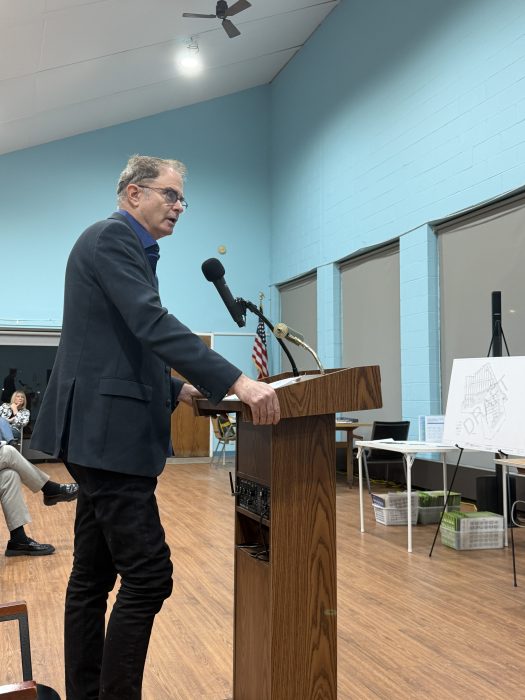
Throughout the forum, village officials reiterated that the comprehensive plan process would include multiple steps, including the selection of a professional planning consultant through a formal request for proposals, the formation of advisory committees and additional public meetings.
The forum concluded with additional resident comments, reinforcing a central theme: growth should be deliberate, limited and consistent with the village’s existing character.
Earlier in the evening, the board of trustees held a work session that focused on administrative and infrastructure matters, including traffic safety concerns, emergency notification systems, banking services and recent water main incidents. Public comment was not permitted during that portion of the meeting.
Village officials said more public forums will be scheduled as the comprehensive planning process moves forward.