



The Long Island Association is this year celebrating its 100th anniversary, entering its second century as it commemorates key moments in its own and Long Island’s past,
launches a centennial logo and holds a celebration at the end of the year.
The Melville-based group has created a web page honoring accomplishments and moments over the years, showing how the group’s advocacy helped shape so much we
take for granted on Long Island today.
Some people may talk about a once-in-a-century party, but one is coming up as festivities culminate with a centennial celebration on Nov. 4 at Crest Hollow Country Club to honor business leaders who played a key role in the LIA’s growth.
The group has been a Long Island presence since before the Great Depression, through wars, changes in technology and the recent pandemic, leaving its mark on
everything from the economy to energy to education.
The LIA has been a key force in the region’s transformation from potato farms and beach cottages to America’s first suburb, and into an economic powerhouse and a region home to nearly 3 million people.
“Over the course of a century, the Long Island Association has played an instrumental role in transforming the region from a bedroom community of New York City to a
dynamic, vibrant place,” LIA CEO and President Matt Cohen said, describing the region as one with a “diverse, bustling economy that offers exciting opportunities for
professional success.”
The group has long been a loud voice for Long Island, helping make sure the region is not lost in the hubbub and tussle for funds in Albany, with vocal leaders such as
Matthew Crosson and Kevin Law, as well as Cohen, maintain a laser focus on Long Island.

“For an organization to last 100 years, it must have a clear mission that is achievable with strong leadership that advances its goals,” LIA Chair Larry Waldman said. “Our
economy doesn’t shape us, we shape it, and it’s up to us to ensure that we can create jobs — the best social program — and people can afford to live in this beautiful place we
call home.”
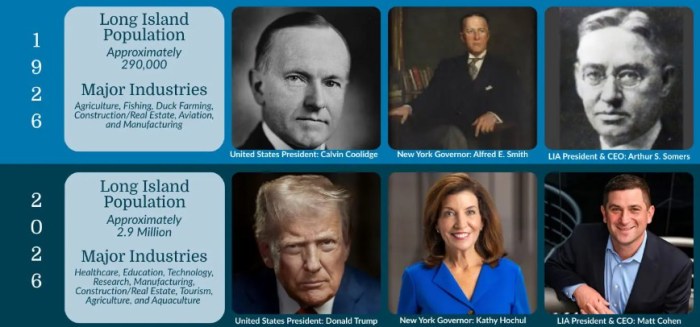
What would become the LIA was founded in 1926 as the Long Island Chamber of Commerce, based at 20 W. 34th St. in Manhattan with Arthur S. Somers as its first president.
The New York Times, in an April 1926 article, said the organization was created to “tell the world about Long Island” as it sought to attract New York City businesses.
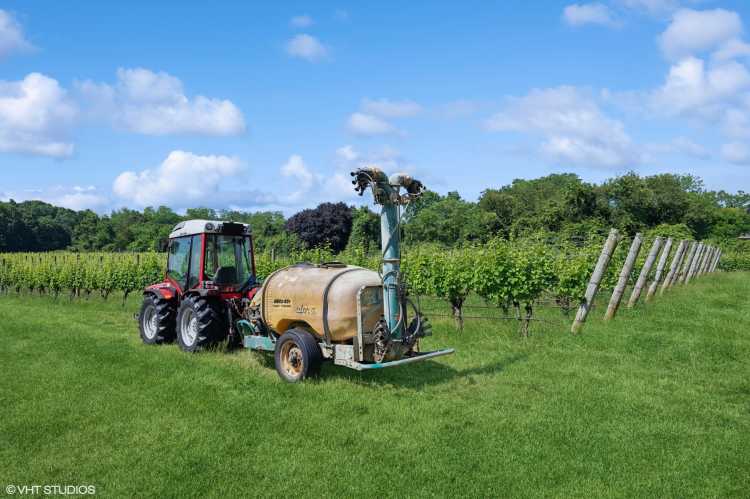
Long Island’s population at that time was 290,000, and the region’s major industries included agriculture, fishing, duck farming, construction, aviation and manufacturing.
The group, in its early years, advocated for the construction of the Queensboro Bridge upper roadway, as well as setting aside more than 17,000 acres of parkland, which
would later become Jones Beach State Park and Bethpage State Park, which would host the US Open in 2002 and 2009.

“The LIA was established as the voice of the business community and has shepherded progress in Nassau and Suffolk Counties through regional leadership,” the group says
on its centennial webpage, “so our home continues to be an unparalleled place to live and work.”
The LIA in 1939 participated in the World’s Fair in Flushing Meadows, carrying the banner for Long Island while showcasing the work of Walt Whiman and others. They in 1928 held their first Long Island Convention and by 1936 changed their name to the Long Island Association.
They moved their offices from Penn Station to Nassau County in 1949, centralizing operations closer to their membership. And by 1959, they formed a government affairs
committee to influence policy and local legislation, formally entering the advocacy arena.
Former Securities and Exchange Commission chairman William J. Casey, in 1968, became LIA president before leading the Central Intelligence Agency under President
Ronald Reagan.
The group in 1973 supported legislation to standardize education goals in public schools, strengthening workforce readiness, and the LIA Housing Committee in 1988
created the Long Island Housing Partnership, addressing affordable housing needs.
They hosted the first Long Island Economic Summit in 1991 to discuss the future of Long Island, and in 1994, they supported the implementation of HOV lanes on the LIE from Exits 49 to 57.
The group also launched the LIA Health Alliance in 1994 to support employer-based health initiatives, addressing a key issue in healthcare that would remain a significant concern for Long Island and the nation.
The LIA in 2017 secured hundreds of millions of dollars in state funding for the Transformative Investment Program, supporting a Research Corridor and major
infrastructure projects in Nassau County and the Ronkonkoma Hub.
The LIA advocated for a third LIRR track from Floral Park to Hicksville and, in 2020, helped businesses obtain loans, grants, and information during the pandemic.
They supported the development of the Ronkonkoma Hub and the continuing growth of Station Yards.
The LIA in 2024 supported South Fork Wind, the first utility-scale offshore wind farm in the United States, while opposing a fully public Long Island Power Authority as not being in the ratepayers’ interest.
The LIA in 2024 also issued its first East End Advocacy Agenda and in 2025 successfully helped advocate for a higher federal State and Local Tax (SALT)
deduction.
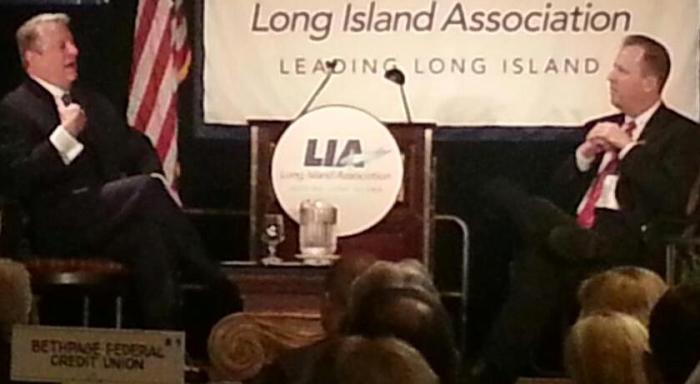
The group’s annual luncheons have presented former presidents, vice presidents,
governors and sports legends, while the LIA Foundation, the not-profit’s charitable arm,
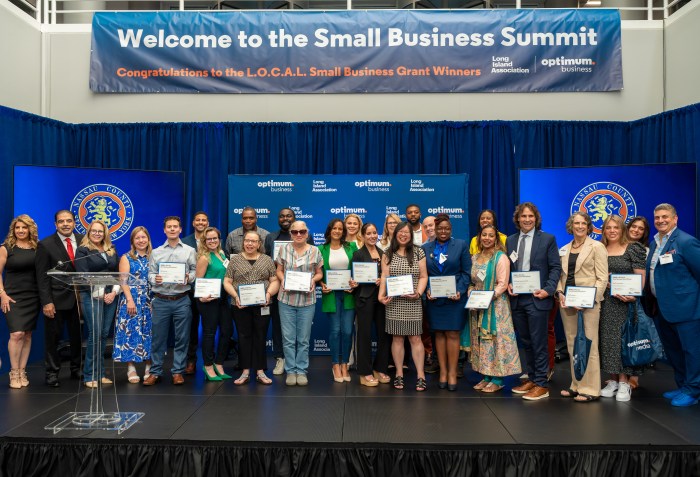
supported small Nassau and Suffolk businesses through grants.
“The LIA has been a staple of Long Island and influential in ensuring our region’s success because it was and continues to be driven by the business community who
help usher in continued economic growth,” Waldman said.
The group at the centennial celebration plans to celebrate the end of its first 100 years and the beginning of its next as Long Island, with about 2.9 million residents, continues to evolve.

The region with reviving downtowns is home to major industries such as healthcare, education, technology, research, manufacturing, construction, real estate, tourism,
agriculture and aquaculture.
“With a proven legacy of accomplishments, our nationally recognized organization will continue to capitalize on our assets,” Cohen added, “confront various challenges, and ensure that Long Island’s future is bright, sustainable, and maximizes our full economic potential.”