



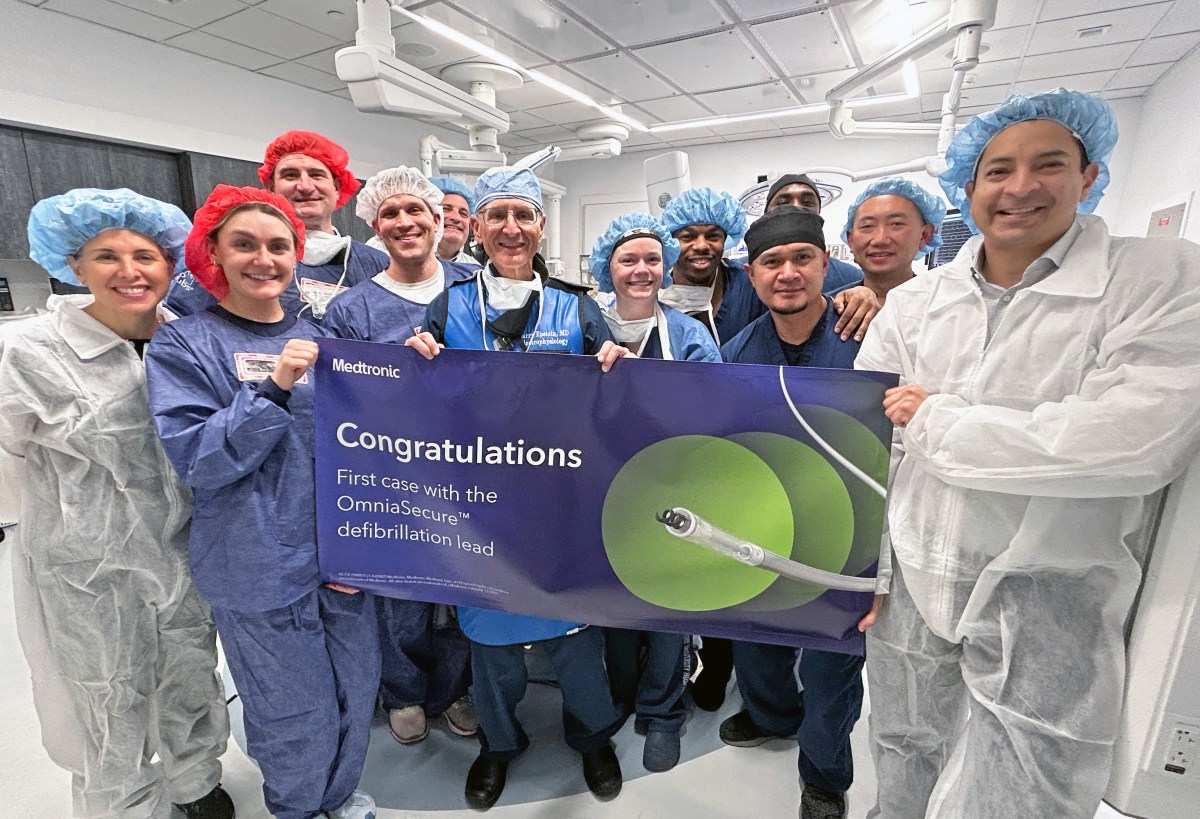
North Shore University Hospital’s cardiology team became the first to complete a procedure using the novel OmniaSecure defibrillation lead on Jan. 7, a landmark in the field of electrophysiology.
The hospital performed a procedure, implanting the defibrillation lead, the industry’s smallest, into a 77-year-old patient, according to a statement from the hospital.
“This novel lead represents a significant advancement in cardiac device technology. For the first time, we can provide both life-saving defibrillation and physiologic pacing through a single, streamlined device,” Laurence Epstein, system director of electrophysiology at Northwell Health, said.
Epstein said the patient in the first procedure went home within 12 hours.
The device is capable of correcting or interrupting abnormal heart rhythms, which can cause sudden cardiac arrest, by receiving live transmission from a cardiac lead.
“It’s like having a paramedic implanted within you,” said Epstein.
The new OmniaSecure lead, from Medtronic, was approved by the U.S. Food and Drug Administration in April 2025.
“FDA approval for the OmniaSecure defibrillation lead furthers our ability to offer physicians and patients a transvenous solution designed to be smaller to help minimize complications, including vascular complications and valve interaction, with strong, reliable lead durability,” said Alan Cheng, chief medical officer of Cardiac Rhythm Management, a subset of Medtronic.
Epstein said patients can receive this procedure if they are in one of two categories: primary prevention or secondary prevention. Primary prevention means a patient has been deemed to be at risk for a life-threatening cardiac problem. Secondary prevention means that a patient has previously had ventricular tachycardia, ventricular fibrillation, or cardiac arrest and survived, signalling they are at risk for further complications.
Epstein has high hopes for the procedure moving forward.
“We were involved in the clinical trials that got this approved, and the success rate for implanting this lead was well over 95%,” he said. “It hopefully will reduce the overall complication rate, because the lead is much smaller.”
He said that this advancement will allow more people to benefit from this type of therapy.