



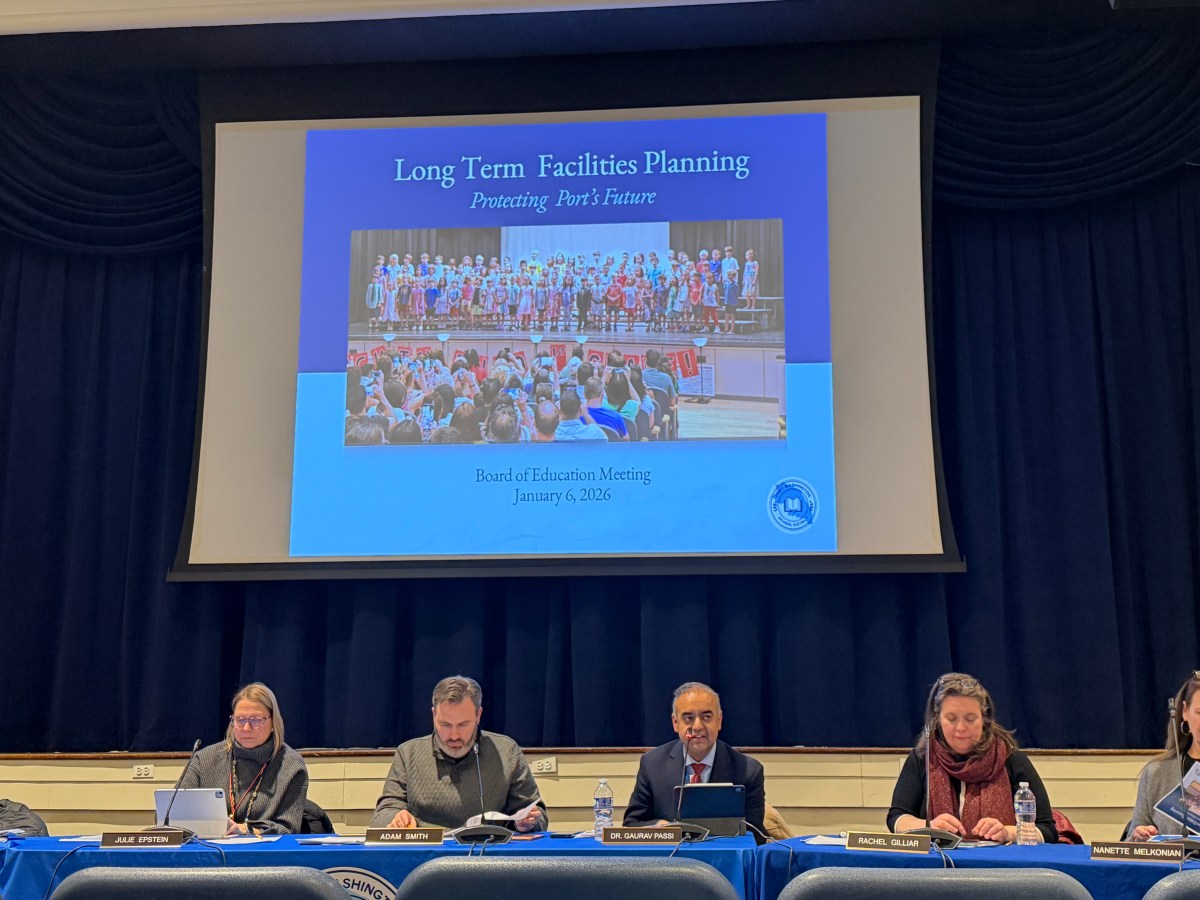
Facing aging school buildings and mounting long-term infrastructure needs, Port Washington School District officials on Jan. 6 laid out a detailed roadmap for facilities planning as part of the district’s early budget discussions for the 2026–’27 school year, warning that deferring major work could increase costs, risks and disruptions in the years ahead.
Assistant Superintendent for Business Kathleen Manuel and Director of Facilities and Operations Brian Graham presented the district’s “Long Term Facilities Planning” overview to the Board of Education, grounding their recommendations in the most recent building condition survey and decades-long trends in capital investment.
According to the presentation, district facilities are currently “operational, safe, and supported by consistent annual investment,” but many major systems — including roofs, HVAC, electrical and structural components — are aging and in some cases already past their intended lifespan.
“The survey makes clear that while our buildings are functional today, reliability cannot be assumed without intentional long-term planning,” Superintendent Gaurav Passi said. “We are approaching a point where the scale and complexity of the work required goes beyond what annual maintenance alone can reasonably address.”
The building condition survey categorizes facility needs into three priority levels: approximately $36 million in critical safety and compliance work, $45 million in essential infrastructure replacement to maintain operations, and $65 million in modernization and improvements to educational spaces, totaling more than $140 million in long-term needs.
Passi explained that priority one projects include safety and security upgrades, such as communication systems, door hardening and other work necessary to keep schools operational and compliant with regulations.
Priority two and three projects focus on aging infrastructure and modernization efforts, including heating and cooling systems, flooring, roofs and classroom environments. While many of these systems still function, Passi said inefficiency and the risk of sudden failure continue to increase.
Passi said the building condition survey shows that relying on incremental repairs and phased projects over time can increase long-term costs, as deferred work often leads to inefficiencies, emergency repairs and greater disruption to school operations.
As part of the proposed 2026–27 operating budget, administrators recommended a $4.4 million transfer to capital projects, up from $4.2 million in the current year. The proposed allocation includes $2.5 million for repairs to the Manorhaven Elementary School retaining wall, $1.7 million for roof, masonry and HVAC work at Daly Elementary School, and $200,000 for flooring replacement and abatement at Guggenheim School.
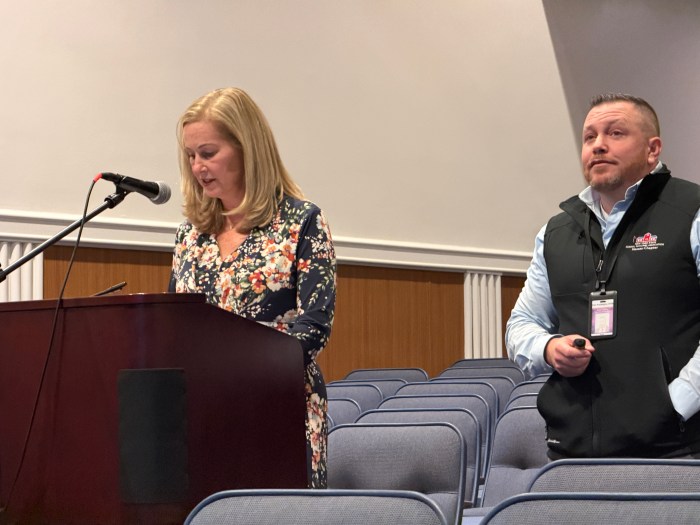
Manuel said the district has historically relied on annual capital transfers and voter-approved bonds to fund improvements, including a facilities improvement capital reserve established by voters in 2022. That reserve, designed to address districtwide HVAC and electrical infrastructure needs, had a balance of just over $2.1 million as of June 30, 2025, according to the presentation.
The administration also outlined longer-term options, including the possible creation of a repair reserve fund and future borrowing. Passi noted that approximately $10 million in existing debt is scheduled to roll off in the 2030–31 school year, which could help offset the tax impact of future large-scale projects if planned strategically.
“The building condition survey underscores that the district faces a strategic decision,” Graham said. “We can continue relying on incremental approaches, or we can adopt a more comprehensive long-range facilities strategy that aligns safety, educational priorities and fiscal stewardship.”
Several board members expressed support for proactive planning. Trustee Rachel Gilliar said the district has made progress by addressing facilities issues earlier rather than waiting for emergencies.
“It’s an important shift to be thinking ahead instead of waiting until we literally have water on our heads before deciding to act,” Gilliar said during the discussion.
Public comment later in the meeting expanded the budget conversation beyond facilities.
Kara Miller, a parent in the Port Washington school district, urged the board to examine how budget priorities — particularly those related to literacy instruction — can have long-term financial consequences.
“With a budget of nearly $200 million, we have a responsibility to look critically at where funds are allocated,” Miller said. She argued that inadequate investment in evidence-based reading instruction can lead to costly legal disputes when students fail to make progress.
“Every time a family files for a due process hearing because their child is not making progress in reading, the district incurs tens of thousands of dollars in legal and administrative costs,” Miller said. “Those dollars do nothing to help the children sitting in classrooms the next morning.”
Miller called on the board to consider redirecting funds toward teacher training in structured literacy approaches, saying proactive investment could reduce inequities and long-term expenses.
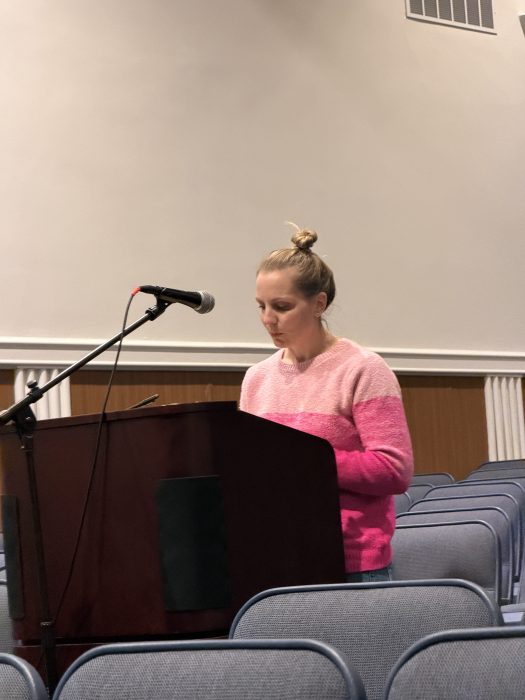
“For the cost of one or two legal appeals, we could train an entire grade level of teachers,” she said. “Literacy should be a right for every student, not a privilege reserved for families who can afford private tutors or attorneys.”
Board members did not respond directly to Miller’s questions during the meeting but reiterated that budget planning is in its early stages and that additional data, presentations and public input will be reviewed in the coming months.
Earlier in the meeting, board president Adam Smith addressed an old business item raised by community members regarding whether the board supports a “do no harm” policy. Smith said the board continues to review the issue through its policy committee and emphasized that no final decisions have been made.
“The board is still discussing this, and the policy committee is actively reviewing it,” Smith said, adding that additional data and recommendations would be brought forward before any action is taken.
District officials emphasized that the Jan. 6 presentation marked the first step in a multi-month process, encouraging community members to participate as discussions continue ahead of budget adoption in the spring.