



New York State’s evolving graduation requirements and what they could mean for Jericho students dominated discussion at the Jericho Board of Education’s Thursday, Dec. 11, meeting, as administrators outlined proposed statewide changes and board members raised questions about academic standards, equity and local control.
Assistant Superintendent for Curriculum and Instruction Ivy Sherman said New York State’s graduation rates were dipping, and demographics have changed that led to New York State’s proposed “Portrait of a Graduate” initiative. The effort, developed by a state Blue Ribbon Commission, is intended to rethink what it means to earn a high school diploma as graduation rates decline and workforce expectations shift.
State officials, Sherman said, believe relying almost exclusively on Regents exams no longer captures the full range of students’ skills and abilities. The proposed framework emphasizes six competencies: academic preparedness, creative innovation, critical thinking, effective communication, global citizenship, and being reflective and future-focused.
“These are still in the proposal and planning stage,” Sherman stressed, noting that no changes have yet been written into the state’s Part 100 regulations, which govern graduation requirements. Current Regents exam requirements remain in effect, including for students graduating this June.
Sherman said the state is moving toward broader assessment options such as performance-based projects, presentations, portfolios and real-world experiences, while maintaining high expectations and alignment with state standards. Regents exams would continue to be offered and appear on transcripts, but under the proposal would no longer serve as the sole “gatekeeper” for graduation.
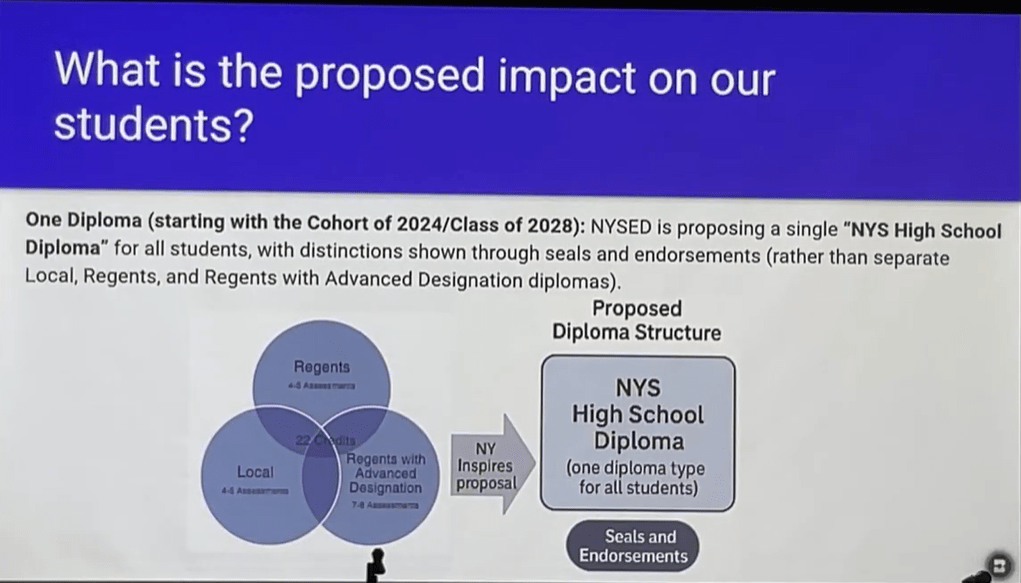
Board members questioned how the proposed changes would affect diploma types. Sherman explained that the state plans to move from three diploma types — local, Regents and Regents with advanced designation — to a single diploma, beginning with students currently in 10th grade. Distinctions such as honors, mastery and advanced coursework would still be recognized through seals and endorsements.
Some trustees expressed concern that increased local discretion could weaken statewide accountability. One board member warned that a single diploma could make it harder for colleges or employers to distinguish between students from different districts.
Administrators responded that learning standards are not being eliminated and that Jericho already holds students to high expectations.
“Standards are not changing,” Sherman said, adding that Regents exams will remain one measure of proficiency even if they are no longer required to graduate.
The board also discussed proposed additions to graduation requirements, including a mandatory career and technical education credit for students currently in seventh grade and beyond. Sherman said Jericho is already well positioned, with an estimated 80% to 90% of current seniors having earned at least one CTE credit through business, technology, family and consumer science or computer science courses.
Proposed statewide instruction in personal finance and climate education was also reviewed. Sherman said both areas are already embedded in Jericho’s curriculum, particularly in science and social studies, though the state has not yet issued detailed standards or assessment guidance.
Another future proposal would create a standardized statewide high school transcript beginning with current fifth graders, potentially including documentation of how students demonstrate the “Portrait of a Graduate” competencies. Administrators said they are auditing current courses to identify where those skills are already taught.
State guidance is not expected until at least 2027, and administrators said they are preparing without making major changes prematurely.
“We want to be prepared when the state hits us with this,” Sherman said. “But there’s literally nothing to do right now.”
No formal votes were taken on the graduation proposals, which remain under state consideration. Board members said they will continue monitoring developments and engaging with the community as more guidance becomes available.