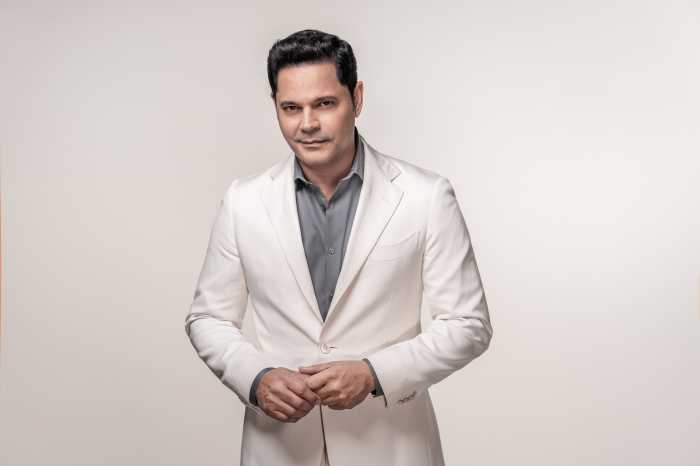




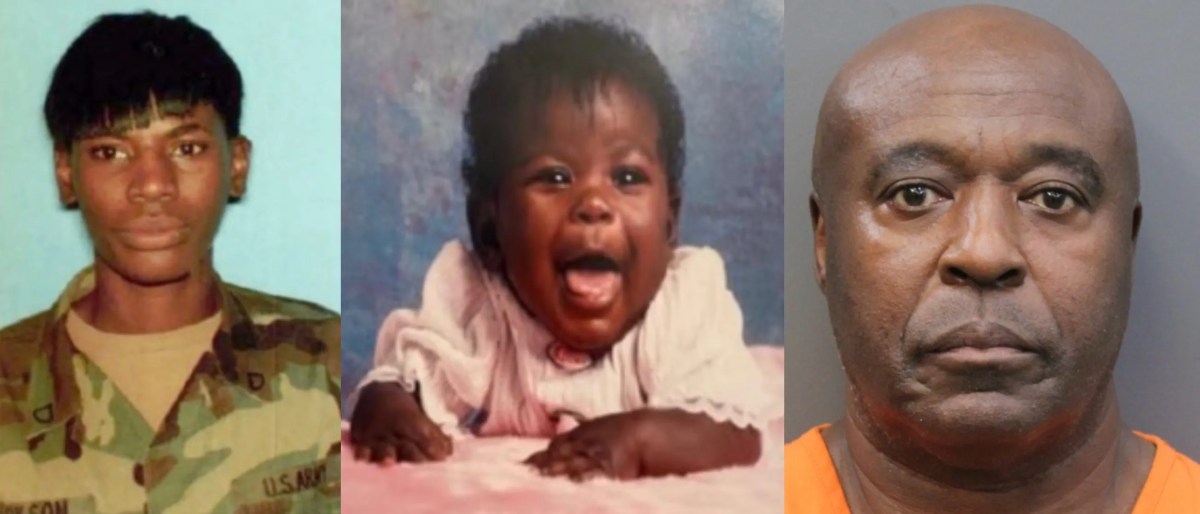
Andrew Dykes has been charged with the murder of Tanya Jackson, formerly known as “Peaches,” whose dismembered body was found in 1997 — but prosecutors have not charged him with the murder of their 2-year-old daughter, Tatiana Dykes.
Dykes, a state trooper living in Florida, pleaded not guilty on Dec. 18 to second-degree murder at Nassau County court. But prosecutors argue he had both the means and motive to kill Jackson, whose torso was found in Hempstead State Lake Park in 1997, and other remains found near Jones Beach in 2011. The remains of their daughter were found a few miles east on Ocean Parkway.
“He’s a murderer,” Nassau County Police Commissioner Pat Ryder said. “He destroyed people’s lives. He threw a baby out like the trash into the weeds. He cut the other body up and dumped it in a container and threw it into a sump. What kind of man does that?”
Andrew Dykes and Tanya Jackson were both in the military — Dykes a sergeant, Jackson a Gulf War veteran — when they met while stationed in Texas. They began a relationship and had a child, Tatiana Dykes. Jackson wanted “a future” for their family, prosecutor Ania Pulaski said, but Dykes already had a wife and son in Brooklyn.
“All he had to do was own up to his act,” Ryder said. “He fathered a child. Man up, and we wouldn’t be here today.”
When police questioned Dykes after Tanya and Tatiana went missing in 1997, he denied having ever had a relationship with her. But new DNA evidence, prosecutors say, told a different story.
Vaginal swabs taken from Jackson’s corpse contained Dykes’ DNA, and Tatiana’s birth certificate confirmed he was her father. Dykes was also an instructor of anatomy and physiology and had operating experience, which would explain how Jackson’s dismemberment was done “with surgical precision,” Pulaski said.
However, Dykes is charged only with Jackson’s murder, not for the murder of their baby, whose remains were found a few miles from Jackson’s.
“At this time, we don’t have the evidence to go forward on a prosecution about Tatiana’s murder,” Nassau County District Attorney Anne Donnelly said, adding she is in touch with Suffolk County District Attorney Ray Tierney to work together to find more evidence. She was asked if she personally believes Dykes also murdered Tatiana.
“Yes,” she said. “I do.”
The mother and daughter went unidentified for more than 25 years. Their remains did not include identifying factors like dental records and fingerprints, so Tanya Jackson and Tatiana Dykes were known only as “Peaches” and “Baby Peaches,” after Jackson’s tattoo, until breakthroughs in DNA analysis helped Nassau authorities identify them — and their link to Andrew Dykes — in 2023.
“Tanya was the victim of a vile and horrifying act of violence by a person — maybe the only person — she thought she could trust,” Donnelly said. “But we begin the fight for her now. Decades after her cruel and untimely end, we begin the fight to bring her killer to justice.”
Nassau police began surveilling Dykes in October 2024. On Oct. 22, they followed him to a Charlie’s Cheesesteaks in a Tampa mall near his home. Investigators took the styrofoam cup he had been drinking from and extracted his DNA to test against the samples taken from Jackson’s remains nearly 30 years earlier. Prosecutors say it was a match.
Dykes admitted to his relationship with Tanya Jackson and Tatiana Dykes when Nassau police questioned him in December 2024. He claimed he hadn’t known they were dead, and that he had attempted to look for them over the years — but his story “didn’t add up,” Donnelly said. Dykes was arrested on Dec. 3 of this year and was extradited to New York.
“To the family, I want to say, I’m sorry it took this long,” Ryder said. “I’m sorry that this animal got away with what he got away with, instead of being a man and owning up to what he did years ago, and fathering that child, he ran away from it after destroying your lives, your sister’s lives, and that baby’s lives.”
“That animal will spend the rest of his life in jail thinking about that act,” he said.
Dykes’ court-appointed attorney, Joseph LoPiccolo, reserved the bail application during the Dec. 18 arraignment as he had “just met” Dykes and was only familiar with the case through what he’s read in the paper. The court will next meet on Jan. 16, 2026.
In 2016, the Press broke the news that Peaches partial remains were found near Gilgo Beach in 2011. The revelation was sparked by the work of filmmakers Joshua Zeman and Rachel Mills, who produced A&E’s The Killing Season investigating the Gilgo case and other cold case murders, as well as the work of Websleuths.
In 2020, the FBI was tapped to use genetic genealogy to help identify the victim formerly known as Peaches and her daughter. Two years later, the Mobile Police Department in Alabama released Peaches’s tattoo on its Facebook page, seeking relatives of an Elijah “Lige” Howell, who died in 1964 and whose relatives may have been able to assist in identifying Peaches. Howell had multiple siblings but no known children at the time of his death.
FBI agents and Nassau detectives ultimately tracked down the victim’s estranged family, interviewed them and confirmed her identity using DNA, officials said. A private funeral was held over the summer.
Rex Heuermann, an architect from Massapequa Park, has pleaded not guilty to charges of murdering six other women whose remains were found in the bayside brush along the westbound side of Ocean Parkway, as well as a seventh victim found dead in 1993 in the Hamptons. Jackson and her daughter were found at opposite ends of the area where the other victims were found in that case. Heuermann is due back in court on Jan. 13.