



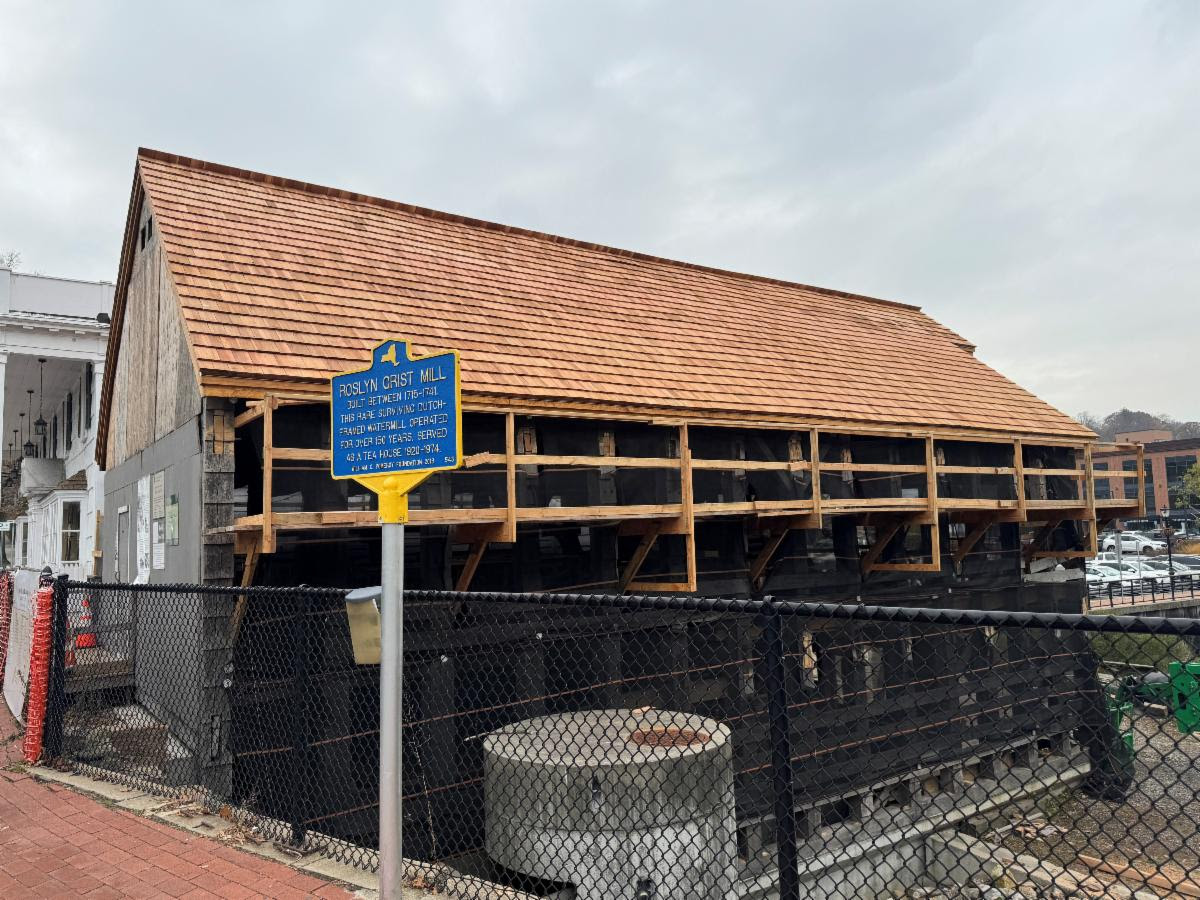
Restoration of the historic Roslyn Grist Mill continues to advance, with newly installed siding samples along the building’s western exterior offering an early preview of how the landmark will appear once the next phase of work is complete.
Over time, the Roslyn Grist Mill’s deterioration occurred naturally as a result of centuries of continuous use, exposure to weather, moisture from the nearby waterway, and the inherent aging of its original materials. The current restoration effort addresses these long-term effects while respecting the mill’s original craftsmanship and historic character.
The samples represent a key step in Phase Two of the long-running preservation effort and reflect the mill’s original late 18th-century construction. Built using vernacular traditions brought to Long Island by early Dutch and English settlers, the structure emphasizes heavy timber framing, hand-cut boards and practical craftsmanship rooted in local materials rather than ornamentation.
Project Director Jennifer Lister of the Roslyn Landmark Society said the siding samples allow architects and preservation specialists to carefully evaluate whether the materials and proportions align with historic precedent.
“Most recently with the mill, we completed the cedar shingle roof, and that was just finished about a month ago,” Lister said. “Then moving from there, we started with the siding samples so the architects can review them and make sure the dimensions are right and everything is historically correct. Once that’s approved, the siding will go on this spring.”
The siding samples are made of white pine, a material commonly used in early American construction. According to Lister, the boards have been treated with pine tar for weatherproofing and to help preserve it over time.
The siding work follows the completion of the new cedar shingle roof in November, a milestone that restored the mill’s historic silhouette while protecting the structure for future generations. That work came after extensive repairs to the building’s timber frame, allowing it to once again function as it did centuries ago.
“We put on some preliminary siding to see how it’s going to fit around the whole building,” said Howard Kroplick, co-president of the Roslyn Landmark Society. “The goal now is to finish Phase Two, which includes completing the exterior, and we hope to have that done this summer.”
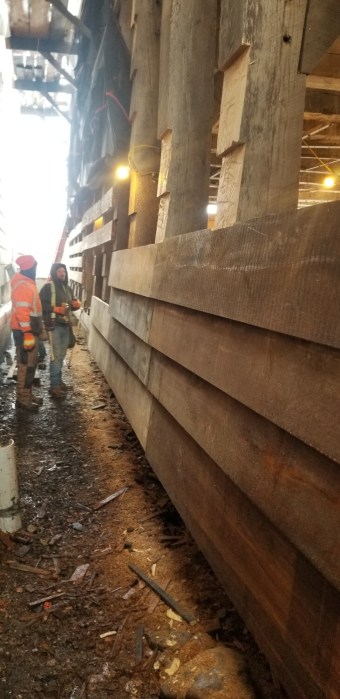
Lister said additional work during Phase Two includes windows, doors and interior flooring, much of which is being prepared during the winter months.
“We’re currently working on the trim for the windows and the doors,” she said. “That can be done as winter shop work, and once that’s designed and completed, we’ll be able to move ahead with installing the siding in the spring.”
The Roslyn Grist Mill, which has stood at the center of the community for more than three centuries, is one of the region’s most significant surviving examples of early American architecture. Its preservation history includes documentation through the Historic American Buildings Survey in the mid-1970s, a federal program administered by the National Park Service and archived at the Library of Congress. That effort produced large-format photographs and measured architectural drawings by John R. Stevens, capturing the mill’s form and construction decades before the current restoration began.
Today, those records continue to inform the ongoing work, providing insight into original materials, proportions and building techniques.
Funding for the project comes from a combination of public and private sources, including Nassau County’s capital plan, New York state grants, local historical foundations, the federal Save America’s Treasures program and private donations.
Lister said Phase Two is expected to be completed by summer 2026, paving the way for the next stage of the project.
“Phase Three is going to include a lot of site work,” she said. “That means the sluice way, the water wheel, exterior accessibility improvements and all the site elements needed to fully complete the project and open it to the public.”
Once Phase Two wraps up, Lister said the team hopes to move into phase three by fall 2026, with full completion anticipated within the next several years.
Both Lister and Kroplick emphasized gratitude for the broad base of support that has sustained the decade-long effort.
“We’re very excited that Phase Two has been so successful and that we’re nearing completion,” Lister said. “We’re incredibly grateful for all of our generous supporters who have made this historic restoration possible.”
When finished, the Roslyn Grist Mill is expected to reopen as a fully interpreted educational site, offering programs, tours and a deeper look into the craftsmanship and community history that shaped Roslyn more than two centuries ago.