




Daren Hornig was a three-sport athlete in high school who paved a professional path for himself in the real estate industry before returning to sports.
After acquiring the Port Washington Tennis Academy, he said, he saw a void in the sports booking industry. The result was his creation of an AI-powered booking platform for tennis, pickleball, and paddle facilities.
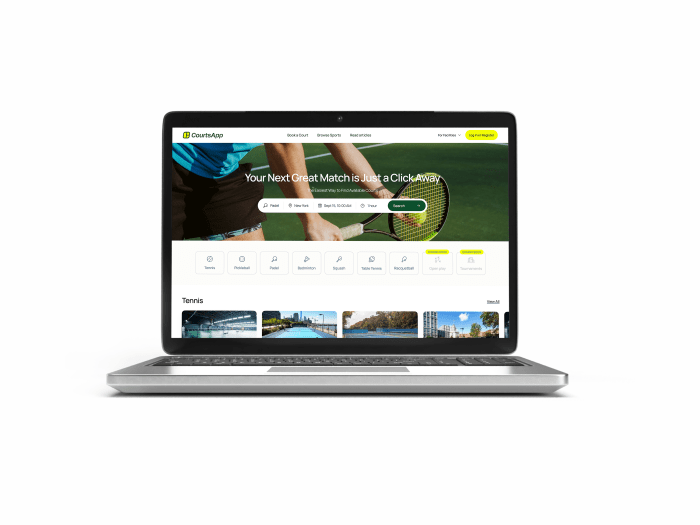
CourtsApp is the first AI-powered marketing and booking platform built to modernize court marketing and reservations.
The beta version of the program launched in December 2025, and its website and app have helped players quickly find and book open athletic courts and removing the friction that keeps people from playing regularly.
“CourtsApp turns your phone into a gateway to real-world health,” Hornig, who is the company’s founder and CEO, said.
Hornig, now a resident of Roslyn, said CourtsApp makes it easy for users to discover nearby tennis and pickleball courts, identify open playing times and connect with others in their local community.
“We’re trying to make the consumer experience a better one and a more flexible one than it has been historically,” he said.
Hornig said CourtsApp promotes full-body movement, outdoor play and authentic human connection without required specialized equipment, digital classes or prolonged screen engagement.
Hornig grew up in Bellmore and played football, basketball and baseball for John F. Kennedy High School before going to the University of Maryland, earning a Bachelor’s Degree in business marketing.
He then worked in marketing and real estate for decades before creating his own real estate firm, Hornig Capital Partners, in 2013.
Hornig said he had the opportunity to buy the Port Washington Tennis Academy roughly five years ago, and with the help of SPORTIME, turned it into the SPORTIME Port Washington John McEnroe Tennis Academy, the largest pickleball facility on Long Island, and it was there that he came to realize that a booking program was a need in the industry.
“What I quickly realized in understanding the racquet sports business and being an entrepreneur is that the racquet sports lacked the technological sophistication of other businesses,” he said. “It didn’t have the technology, the infrastructure, the know-how or the capital to create an aggregated booking platform, and that’s essentially what we did with CourtsApp.”

Hornig said the creation of the program was inspired by his looking to solve a problem that he, as an avid pickleball player, had encountered many times when trying to find a court to play on.
He also said that he’s been a fan of racquet-style sports not just for the love of the game, but because of their physical benefits to the body.
“For years, we’ve been told that you can stay fit and lose weight by walking 10,000 steps a day, taking a Peloton class online or going to a gym. However, sports like tennis and pickleball give you a greater chance to achieve your health and fitness goals and live a longer and healthier life,” he said.
That thinking has also been backed by scientific research, with multiple studies demonstrating the health benefits of playing a racquet sport.
According to a study of over 80,000 adults in the British Journal of Sports Medicine, racquet sports players experienced a 47% lower risk of death from any cause and up to a 56% lower risk of cardiovascular-related death compared to non-participants.
A Copenhagen City Heart study followed 8,500 people for 25 years and found that recreational tennis players will live an average of 9.7 years longer than they would have otherwise.
The benefits stem from a unique combination of aerobic exercise, full-body engagement, mental focus and social interaction, the study says.
Over 1,500 courts and over 150 facilities have already signed on throughout New York, New Jersey, and Connecticut, Hornig said.
Hornig said that CourtsApp is heavily focused on its growth on Long Island, where racquet sports have gained popularity. As of early January, 15 clubs on Long Island use the program, with many more in the process of joining.
The app also plans to extend its reach throughout the U.S. East Coast by the end of the first quarter of 2026, before expanding its market by market as club density increases nationwide, Hornig said.