



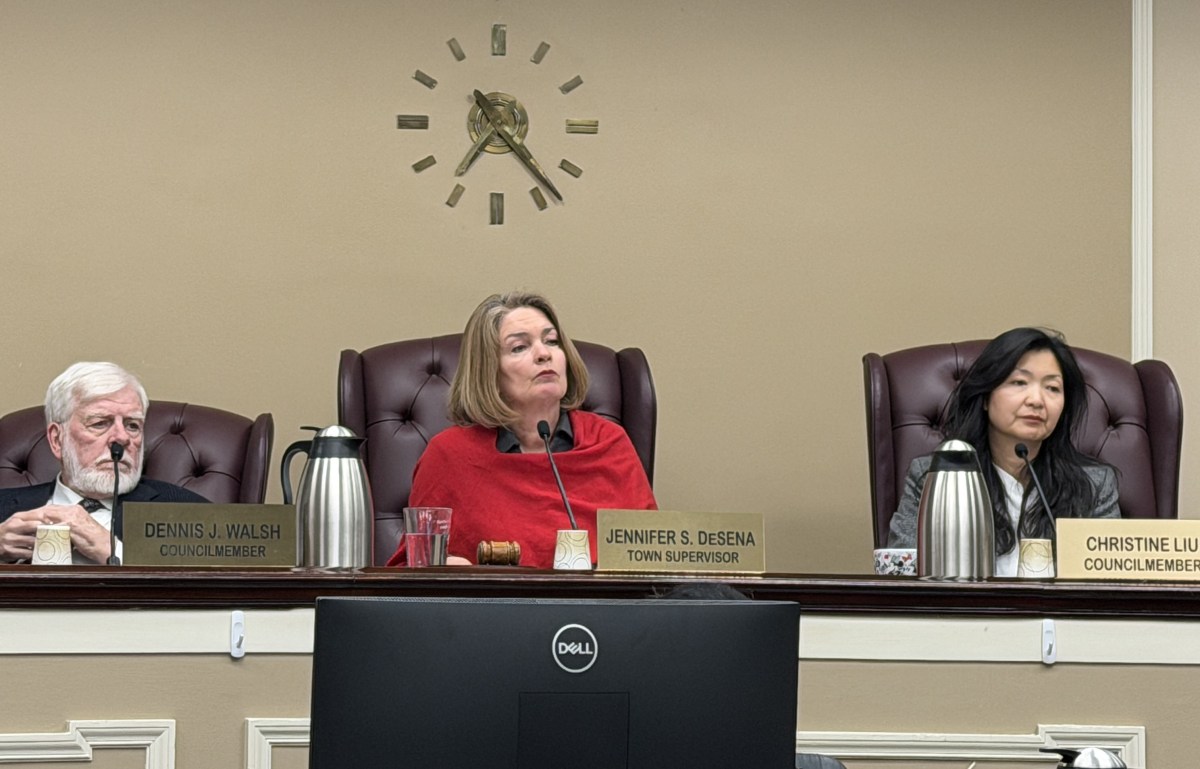
Residents of Manhasset spoke during the public comment portion of the Town of North Hempstead Board meeting on Tuesday, Feb. 3, to voice sharp opposition to proposed electric vehicle charging stations, warning that the installations would bring traffic, safety risks and quality-of-life disruptions to nearby neighborhoods.
Several speakers focused their remarks on plans for commercial-grade EV charging stations in and around the Americana Manhasset area, arguing the project would fundamentally change the character of residential streets while offering little benefit to local residents, according to a transcript of the meeting.
The board unanimously approved a new contract during the Dec. 9 meeting with Lynkwell for 12 electric vehicle charging stations to be installed in town parking lots. Town officials said suggested locations could be adjusted, and the town attorney noted that the sites were not fixed under the agreement.
During the December meeting, Town Council Member Mariann Dalimonte asked that locations be carefully considered to avoid impacting nearby homes and businesses. She specifically cited complaints about drivers leaving their headlights on while their vehicles charge, creating bright light late at night.
John Nash, a Manhasset resident, told the board he opposed using town land for charging stations as currently proposed, calling the project “the functional equivalent of a service station.”
Nash said many local residents who own electric vehicles already charge them at home, making the stations unnecessary for the surrounding community. Instead, he argued, the chargers would primarily serve as a commercial enterprise that would draw outside traffic into residential areas.
Doug Dreyer, who said he has lived in Manhasset for roughly 30 years, echoed those concerns and presented survey data from the Strathmore Village Civic Association showing overwhelming opposition to the project.
Dreyer said 115 people representing 90 households responded to the survey, with 96.5% opposed to installing EV chargers and only 4 respondents in favor.
The written responses, Dreyer said, cited traffic congestion, safety concerns, extended hours of use and potential conflicts with zoning regulations established when a nearby parking lot was expanded in 2012.
At that time, residents had supported converting green space into parking to alleviate congestion, he said, but only after lengthy negotiations and agreements intended to protect the neighborhood.
Dreyer distinguished between smaller, retail-affiliated Level 2 charging stations already operating at businesses like Tesla and Lucid in the Americana and the proposed commercial Level 3 chargers. He described the latter as industrial in scale, powered by large transformers and designed for high turnover, unrestricted public use.
“This is a whole new business,” Dreyer told the board, warning that online queuing systems and lower advertised charging prices could draw drivers at all hours, increasing congestion and noise. He pointed to a Level 3 charging facility near Hillside Avenue in nearby New Hyde Park, which he said is often full late at night and into the early morning hours.
Safety was a recurring theme among residents living closest to the proposed stations.
Another resident, who said she lives about 200 feet from the charging structures, told trustees that the installations violated covenants negotiated years earlier between residents, property owners and the town. She said those agreements were reached after extensive traffic studies and legal review, all paid for by residents.
“Those covenants were broken,” she said, adding that neighbors were never consulted before the chargers were approved.
She also raised concerns about the risk of lithium-ion battery fires, saying local fire departments are not equipped to handle such incidents. A fire at the charging stations, she said, could spread quickly to nearby homes, particularly during high winds. She also warned about strangers entering the neighborhood at “ungodly hours,” calling it a threat to residents who live alone.
In addition to the EV charging station contract, the board approved several other resolutions during the meeting.
Among them was a resolution setting a date for a public hearing to consider a local law amending Chapter 51 of the Town Code, entitled “Taxation.” The proposed law would establish a real property tax exemption for veterans with a 100 percent service-connected disability. The tentative public hearing date for that measure was set for March 10.
The board also adopted a bond resolution authorizing the payment of a judgment in the matter of Gail Selis v. Town of North Hempstead and Port Washington Senior Citizens, Inc., including a third-party action involving the Jewish Association for Services for the Aged.
The case stems from a personal injury lawsuit filed after Selis was hurt in a fall at the Port Washington Senior Center, a town-owned building. Selis, who worked at the center through JASA, alleged she tripped on torn carpeting that had been improperly repaired, causing serious injuries.
A jury found the Town of North Hempstead negligent and awarded damages to Selis. Because JASA operated services at the facility under contract with the town, the town filed a third-party claim against JASA seeking indemnification, arguing the contract required JASA to cover the cost of the judgment.
The resolution states that the estimated maximum cost of the judgment is $1,895,020.83. The board appropriated that amount and authorized the issuance of town bonds in a principal amount not to exceed $1,895,020.83 to finance the payment.
Trustees also approved additional routine resolutions related to personnel and town operations as part of the consent agenda.