



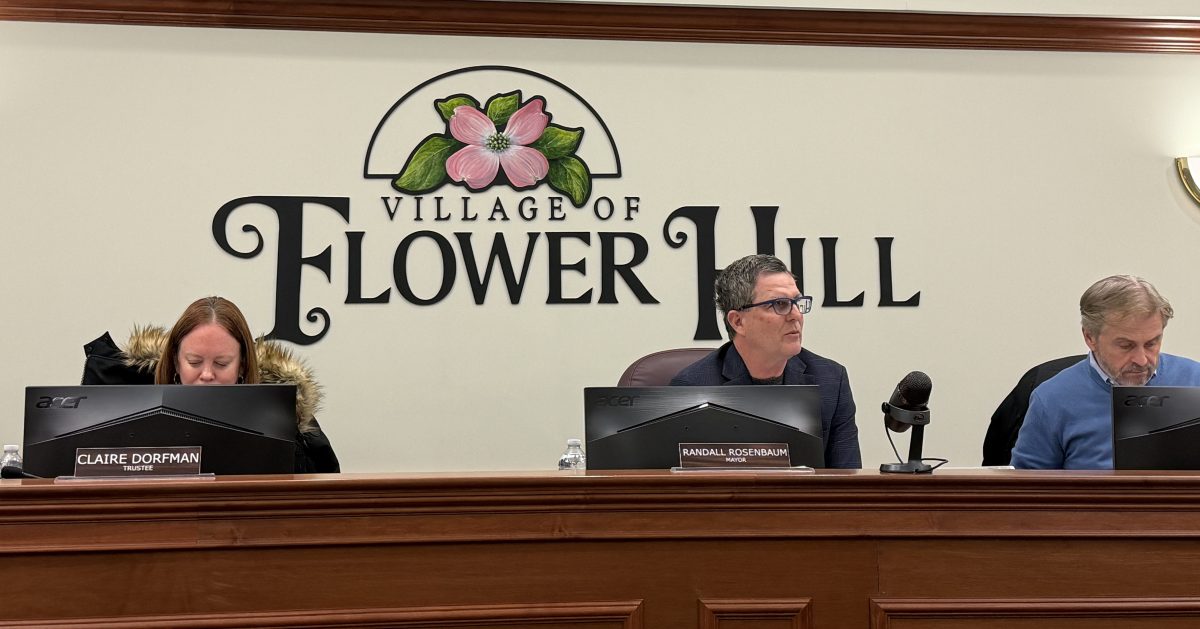
The Village of Flower Hill Board of Trustees took steps toward updating outdated parking fines and tightening restrictions on artificial turf, saying existing village code no longer reflects enforcement needs or the board’s original intent.
Trustees unanimously voted Monday, Feb. 2, to introduce a local law amending the village code, which governs vehicle and traffic violations. Mayor Randall Rosenbaum said penalties for parking offenses have not been revised since 2009 and are too low to deter repeat violations, particularly during construction projects.
“Parking in front of a fire hydrant, there’s only a fine of $100. Double parking in front of a fire hydrant is $75,” Rosenbaum said. “These are the kinds of violations that tend to happen at construction sites, and our current fee structure isn’t really enough to dissuade people from doing these offenses.”
Under the proposal, specific fine amounts would be removed from the code and placed into a fee schedule that could be updated by board resolution. Village Attorney Jeff Blinkoff said the change would make future adjustments more efficient while still preserving public oversight.
“There’s still a public hearing and it’s still discussed,” Blinkoff said. “It just avoids having to amend the code every single time.”
A public hearing on the fine schedule changes is scheduled for the March 2 trustees meeting.
Trustees also voted to schedule a March 2 public hearing on revisions to the village’s artificial turf regulations. Officials said the current code does not clearly reflect the board’s intent to prohibit artificial turf in front yards, an issue that has resurfaced through recent applications.
“The intention really was to specifically not allow it in front yards, but the code never said it explicitly,” Rosenbaum said. “It talked around it.”
Building Superintendent Peter Albinski said the proposed revisions would clarify that prohibition while allowing the board to establish conditions for turf elsewhere on a property, including possible screening, landscaping buffers or drainage review.
“We’re looking to go back to the original intent,” he said. “And possibly provide provisions about location on the property and how it transitions visually.”
The discussion of turf regulations was informed in part by the Architectural Review Committee’s January report. Albinski highlighted six applications reviewed by the committee, including 535 Manhasset Woods Road, a project that has drawn attention in recent meetings.
Albinski said the applicant revised the landscaping plan and removed a proposed front-yard fence after being advised it would require a variance. With those changes, the committee recommended approval.
During board discussion, Blinkoff addressed questions about whether the property was subject to landmark review.
“No landmark nomination has been filed,” Blinkoff said, adding that no application had been submitted to designate the property as a landmark. With no designation pending, the board approved the ARC’s findings, allowing the project to proceed.
In other business, village officials announced Flower Hill received a $50,000 New York State grant for stormwater and drainage improvements. Rosenbaum said the funding will be used to offset engineering costs related to catch basin reconstruction and storm sewer upgrades.
“This helps us move forward with drainage and stormwater improvements without putting the entire burden on taxpayers,” he said.
The meeting concluded with the board entering executive session to discuss confidential matters. The next Village of Flower Hill Board of Trustees meeting will be held on March 2.