



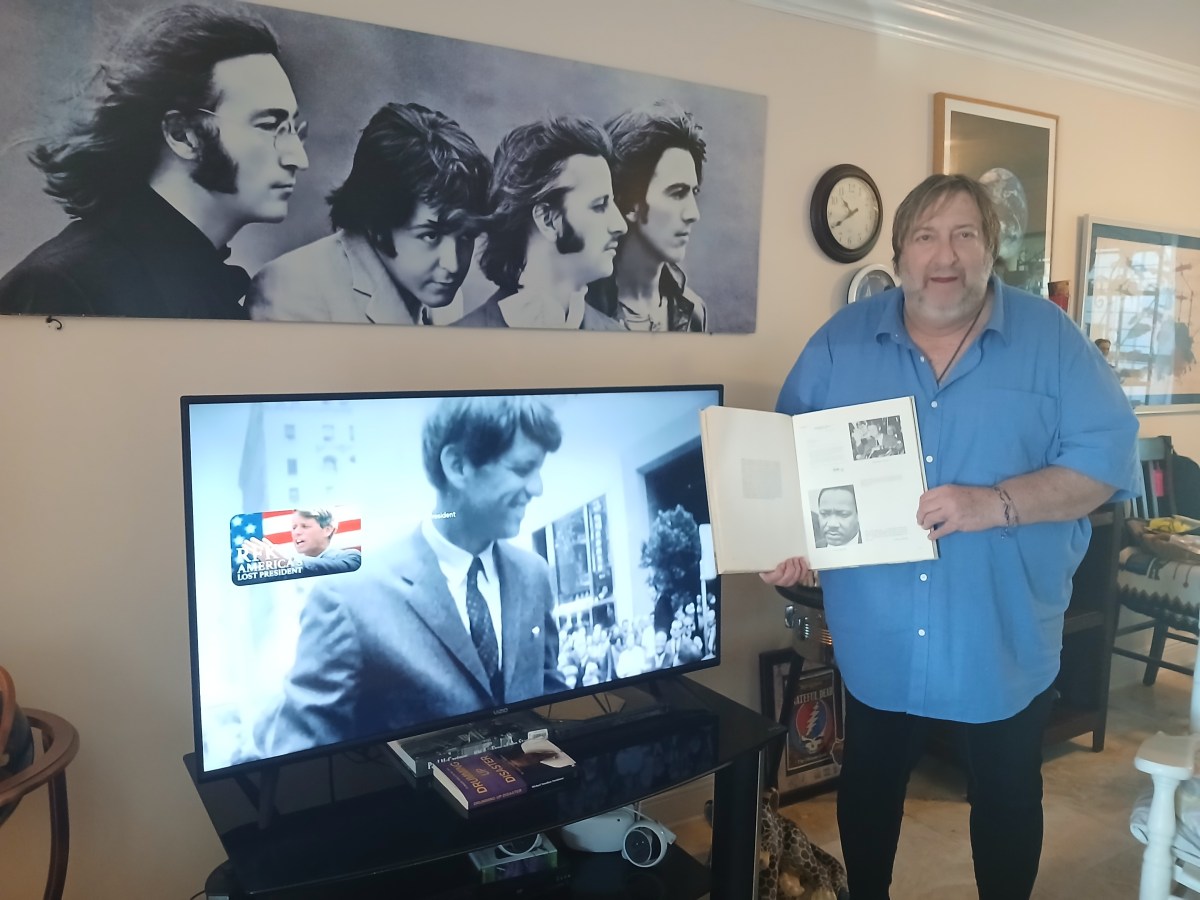
People routinely search for little bits of personal history in yearbooks, but in late January, 1972 Roslyn High School graduate Michael Steinhauer found a piece of national history hidden in his.
He found black-and-white pictures of Robert Francis Kennedy and Martin Luther King in his 1969 freshman high school yearbook known as the Harbor Hill Light, honoring two historic figures who lost their lives the prior year.
“I could understand why they were in the book of 1969,” Steinhauer said. “I knew they were both assassinated within two months of each other in 1968, Martin Luther King in April and RFK in June.”
He read a letter RFK wrote to the students, reproduced in the yearbook, thanking them for writing him after MLK’s assassination. Then Steinhauer noticed the letter’s date, June 4, 1968.
RFK wrote it one day before being shot and two days before he died, making it one of the last things he wrote and signed, on U.S. Senate stationery, including his thoughts.
“Forty-eight hours later, Robert F. Kennedy was killed,” Steinhauer said of his death following the June 5 shooting. “It’s addressed to the class of 1969, Roslyn High School.”
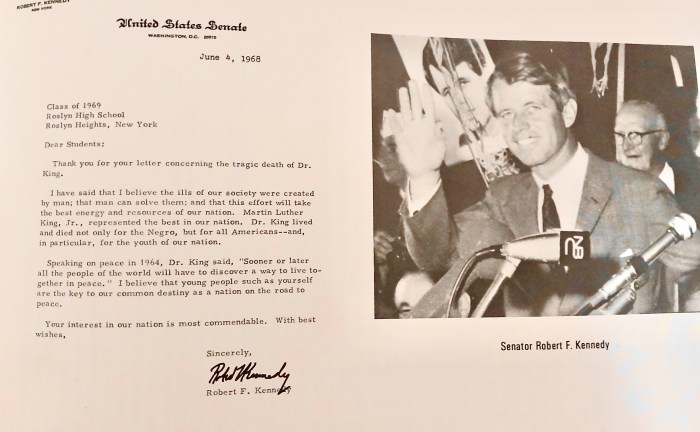
The letter conveys pervasive optimism and a belief in the promise of youth, as well as reflections on MLK. In addition to becoming a comment on MLK’s assassination, it is now, indirectly, a comment from beyond the grave on him.
“The purpose of a yearbook is to record events of our high school years that have influenced our lives,” the editors wrote in the yearbook. “The editors feel they could not accomplish this purpose without trying to give honor to two men who in life and death have had a profound effect upon us.”
RFK thanked the students for writing a letter “surrounding the tragic death of Dr. King,” noting “I believe the ills of our society were created by man,” that “man can solve them and that this effort will take the best energy and resources of our nation.”
“Martin Luther King Jr. represented the best of our nation,” RFK wrote. “Dr. King lived and died not only for the Negro, but for all Americans and in particular for the youth of our nation.”
RFK quoted MLK, who in 1964 said, “Sooner or later, all the people of the world will have to discover a way to live together in peace.”
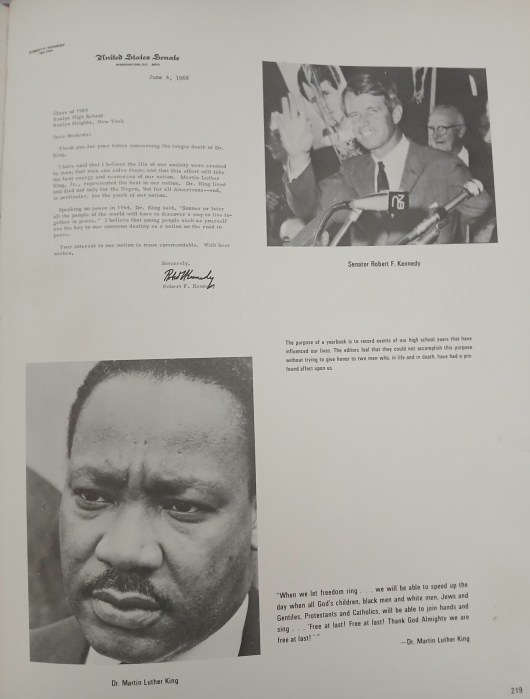
“I believe that young people such as yourself are the key to our common destiny as a nation on the road to peace,” Steinhauer read out loud, his voice cracking.
Next to the photo of MLK is a quote, “Free at last, free at last,” near black-and-white photographs. “Your interest in our nation is most commendable,” RFK wrote.
Steinhauer sees the eloquence and emotion of the letter as, if not last words, an example of noble thoughts just a day before the shooting.
And he believes the fact that the students wrote to RFK speaks well for them as not only being aware, but taking action.
“There was still a moral fiber in the Roslyn High School classes that promoted the notion of writing to RFK to begin with,” Steinhauer said. “And having him return a letter saying it was commendable.”
Seeing the image and reading the text transported him back to that time, remembering the people and the shootings.
“Just shock, disappointment,” Steinhauer said of the two shootings. “Scared, scared about guns, about people being crazy. These days they call it mental health. In those days, it was just people with a gun who may or may not have had a message.”
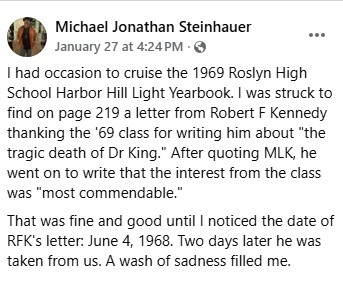
Others commented when he, in a Facebook post, described how he had found RFK’s letter in the high school yearbook, written days before he was assassinated. “I remember that awful morning,” Madlyn Etkind commented.
After graduating from Roslyn High School, Steinhauer graduated from Tufts University in Boston and obtained a master’s degree in public health from Northwestern University in Chicago before holding various jobs, each for about a decade.
He moved to Madison, Wis., to raise a family, ran the health department in Sauk County, helped oversee state licensing of nursing homes for Wisconsin and worked in emergency management for Dane County, writing policies and procedures about managing people with disabilities.
Steinhauer retired, moved to West Palm Beach, and took the yearbook down from a shelf, where he found pictures of familiar people, along with images of two political figures.
“I was astounded that there would be a letter from RFK in the yearbook dated two days before his assassination,” he said. “They happened within 60 days of each other or so. It disrupted my view of the world, how safe it is, and the opportunities. It disrupted what I thought would be the path that Americans took to success.”
Steinhauer wanted others to see the page to gauge how they would react to the letter. Well over 100 people reacted once he posted it on Facebook under “You Grew Up in Roslyn During the 70s.”
“I figured if I was that intrigued and moved by it that others would be intrigued,” he said of his decision to post in that group. “So many people responded to the Facebook post, 125 or so, mostly with sad emojis. I think that this letter reflects the turmoil of those years. And it still resonates on a deep, personal level even though it was so long ago.”
He said he believes that at that time music was frequently political, including the song “Ohio” about Kent State. And music has brought him back to those years many times and continues to do so.
“I connected to music, songs like Ohio and Woodstock, in August of ’69,” Steinhauer said. “There was a connection between what I’m seeing on this page and the music, culture, the milieu of being a high school student in the late ’60s and seeing this brought back a lot for me.”
Steinhauer believes students made the right decision to include the letter and that yearbooks, in addition to helping people remember their time in high school, are about that time itself, including people who affected those in the yearbook.
“I maintain that’s still true today, by the reaction I got,” Steinhauer said. “ We honor these two men in life and death.”