



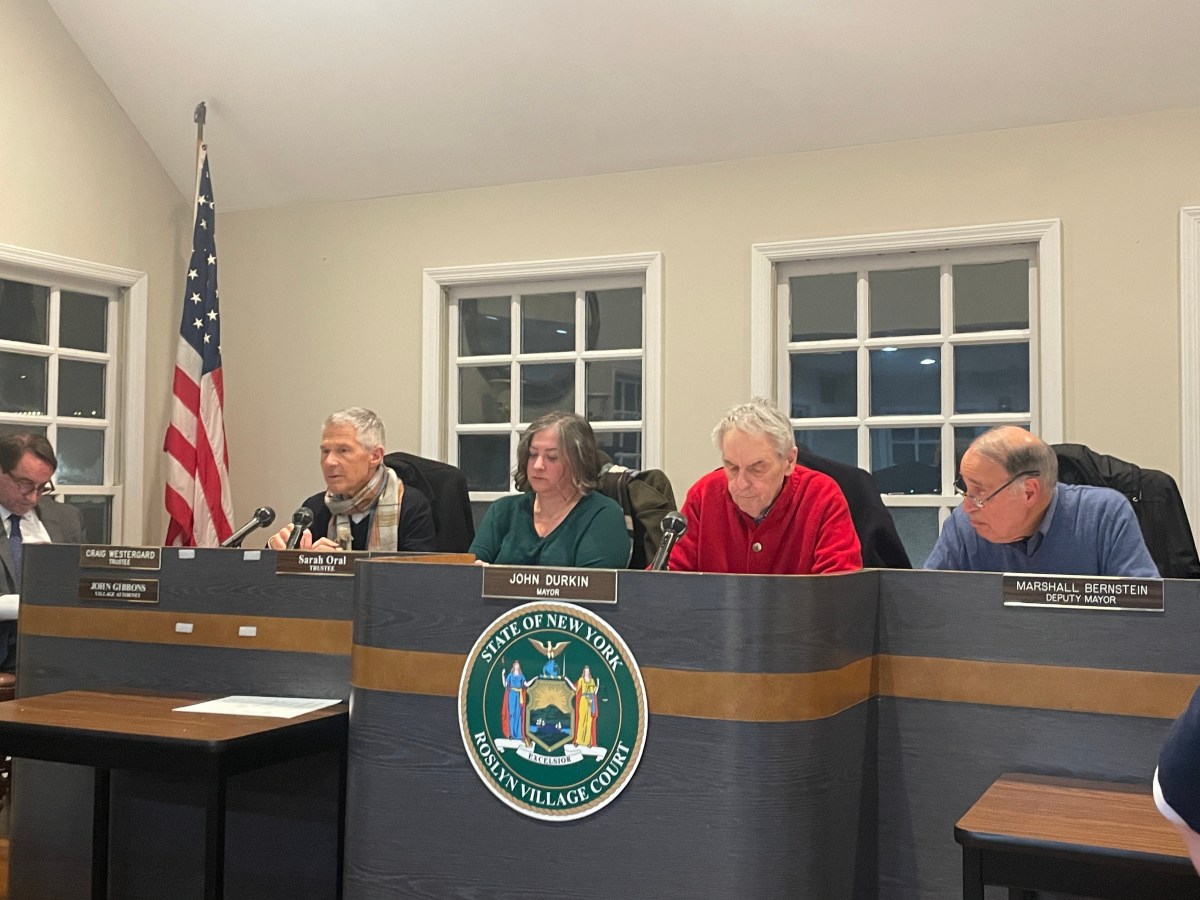
The Roslyn Board of Trustees reviewed complex land-use proposals involving hillside protection, stormwater management and zoning compliance, with discussions centered on a proposed new home on Pine Drive North and a potential two-lot subdivision on Remsen Avenue during its Tuesday, Dec. 16 meeting.
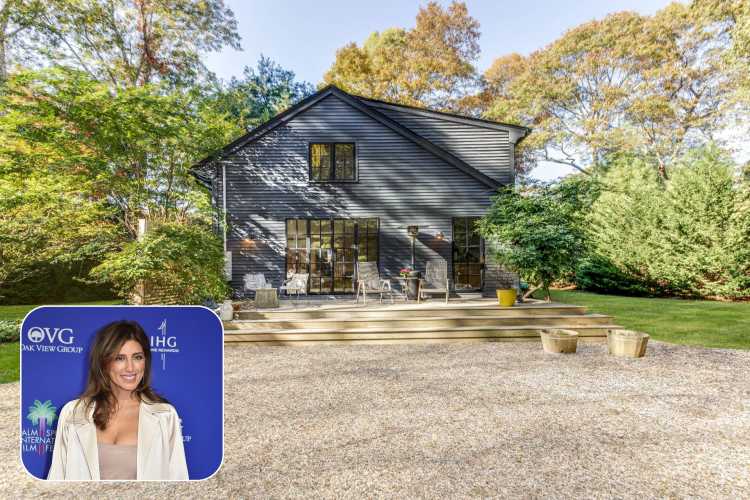
One of the most detailed presentations concerned an application to replace an existing home at 28 Pine Drive North, a property located within the village’s Hillside Protection Overlay District.
Because of the steep slope and prior stabilization work on the site, the proposal requires approval from multiple village boards, including the Zoning Board of Appeals and the Architectural Review Board.
Attorney Kevin Walsh, representing the homeowners, told trustees the project was designed specifically to protect the hillside and preserve an extensive retaining wall system installed years ago.
“We are not upsetting the slope,” Walsh said. “We’re not upsetting the retaining walls this client installed years ago to protect the slope, and we managed to design a home that is totally protective of the existing slope.”
Walsh said the homeowners previously spent hundreds of thousands of dollars constructing retaining walls after experiencing movement on the property and are now seeking to replace what he described as a dated house with a new residence designed for long-term use.
“This is their dream home,” he said. “They’ve lived here a long time, and they hope to live here many, many more years.”
The proposed house requires variances related to height and floor area ratio because of the site’s grade. Walsh said the home would remain under the village’s 30-foot height limit at the front but would exceed the allowable height by 3.92 feet at the rear due to the slope.
Architect Jared Mandel told trustees the house was designed to fit the character of the surrounding neighborhood while addressing significant site constraints.
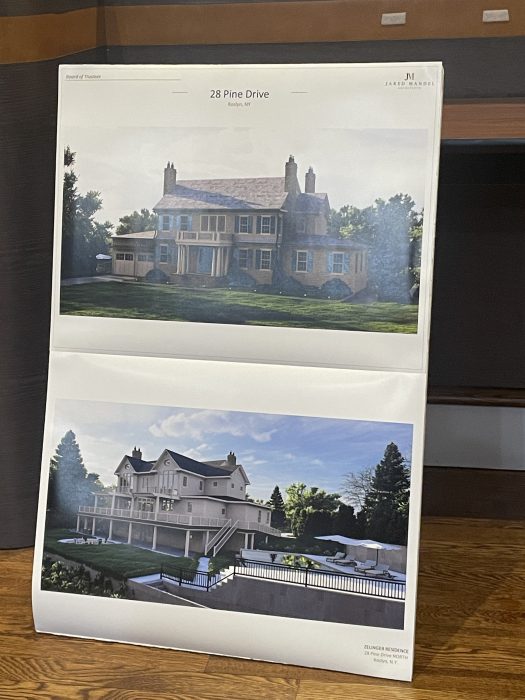
“This is a difficult slope. It’s a difficult site,” Mandel said. “The whole intention behind the design of this house was to make sure that we’re not affecting the grade as we start to build.”
Civil engineer Doug Castellano of North Coast Civil explained that the new house would be built largely in the same location as the existing structure and that stormwater would be fully contained on-site.
“We created a high point at the property line and pitched water back into the property,” Castellano said. “This way we were able to adequately contain it on-site and not shed any water to the lower areas.”
Trustees asked detailed questions about a proposed pool at the rear of the property and its proximity to existing retaining walls. Structural engineer Robert Bennett of Rabco Engineering said both the house and pool would be supported by deep foundation piles to avoid placing additional load on the hillside.
“Anything that’s going to go on top of that will be on helical piles,” Bennett said. “There will be no additional load effect onto that retaining wall.”
While much of the discussion focused on engineering and slope stability, Trustee Craig Westergard raised concerns about how the proposed home would fit within the existing neighborhood.
“My concern is context,” Westergard said. “How the house sits in relation to the other homes around it is extremely important.”
Westergard said that while construction quality and materials are important, they are not the primary issue when evaluating neighborhood character.
“For someone who’s worked in this community for 35 years, appropriateness is more important than just quality,” he said. “You can build something very expensive and still have it not fit.”
He referenced the creation of the Architectural Review Board, saying it was established specifically to address concerns about scale and compatibility in Roslyn neighborhoods.
“That’s exactly why the Architectural Review Board was created,” Westergard said. “To make sure that one approval doesn’t set a precedent for other projects that don’t belong in that neighborhood.”
After reviewing renderings showing the home in context with neighboring properties, Westergard acknowledged that the visuals helped address some of his concerns.
During public comment, a resident expressed concern about the size of the proposed home and the potential for precedent-setting development.
“This is a very, very big house,” said one resident. “Is this the beginning of people coming in and wanting to build mega homes in the Pines?”
Village Attorney John Gibbons responded by clarifying the limited scope of the board’s authority.
“What is before this board is protection of the hillside,” Gibbons said. “Is the building of this house going to cause the hillside to fail? That’s the sole issue here.”
The board unanimously approved the application for 28 Pine Drive North.
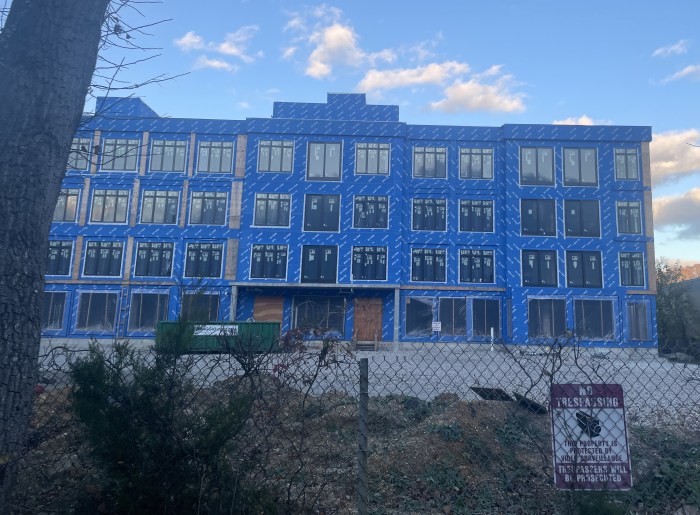
Later in the meeting, the board held its first sketch plan conference for a proposed subdivision at 31 Remsen Ave., where the owner is seeking to divide a single parcel into two residential lots while maintaining the existing home.
Attorney Joshua Brookstein, representing the property owner, said there is no intention to demolish the existing residence, which was built in 1928.
Engineers explained that while both lots meet gross lot size requirements, deductions for steep slope areas result in net lot area deficiencies, requiring zoning variances.
“If this was a flat property, the subdivided lots would be in conformance,” Castellano said who represented both properties. “The only reason they are not is because the steep area in the back is restricted from being built upon.”
Trustees unanimously approved the application.