


A federal judge in Washington, Ana C. Reyes, has blocked the Trump administration’s attempt to revoke Temporary Protected Status for approximately 350,000 Haitians living in the United States, bringing a sanctuary to thousands of families on Long Island — particularly in Elmont, where one of Long Island’s largest Haitian communities lives.
The ruling pauses a policy that would have stripped legal status from Haitian immigrants at a time when Haiti continues to face an unstable political situation, widespread violence and a growing humanitarian crisis. TPS allows people from countries in crisis to live and work legally in the United States when returning home would be unsafe.
Temporary Protected Status is a humanitarian program established by the U.S. government in 1990. It grants temporary legal status and work authorization to immigrants already in the country who come from nations experiencing ongoing armed conflict, natural disasters, or other extraordinary conditions that prevent safe return. The goal of TPS is to offer a safe haven during crises without permanently altering immigration status, providing stability to individuals and families until conditions improve in their home countries.
Historically, countries like El Salvador, Honduras, Sudan and Haiti have received TPS. For Haitians, TPS was first granted after the devastating earthquake in 2010 that left the country in ruins. Since then numerous crises, including political instability and violence, have extended the designation. The program has helped thousands of Haitians live and work legally in the U.S., contributing to their communities while awaiting safer conditions back home.
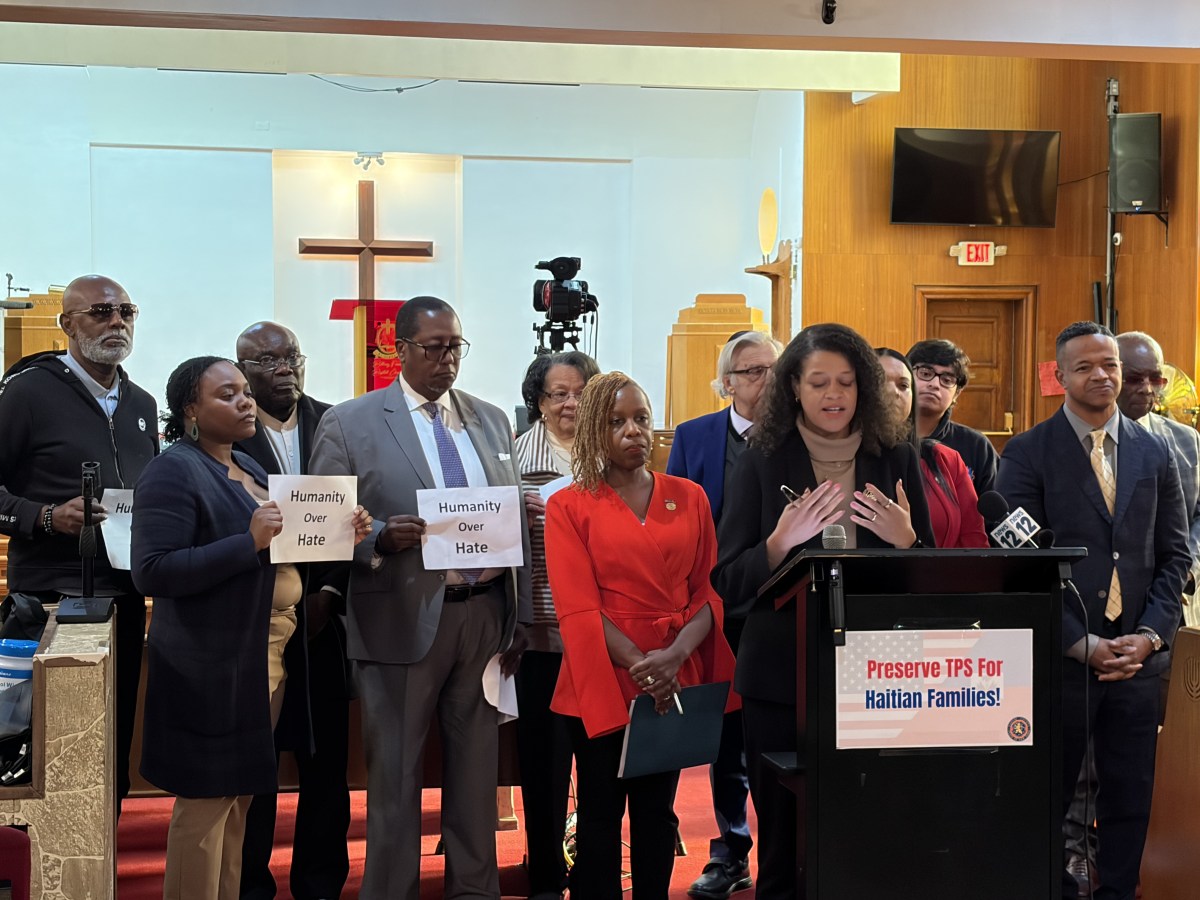
Local elected officials, healthcare workers, and community leaders gathered in Elmont following the decision to speak out about what the ruling means — and what is still at stake.
Assemblywoman Michaelle Solages, the first Haitian-American elected to the New York State Legislature, represents a district with a large Haitian population and has been a leading voice on the issue.
According to Solages, there are hundreds of TPS holders in her district alone. In Nassau County, there are more than 1,000 individuals living under TPS. Across Long Island — which includes Nassau and Suffolk counties — about 30,000 Haitians live in the region, according to the Long Island Community Foundation.
Elmont is one of the largest centers of the Haitian community on Long Island. Solages said Valley Stream also has a large Haitian population, along with Baldwin, Freeport, and Uniondale.
“These are communities where people have lived for years,” Solages said. “They’ve raised families here. This is home.”
Solages accused the Trump administration of unfairly targeting the Haitian community and other immigrant groups of color through efforts to end TPS.
“If you look at the trends, they are targeting countries with large immigrant populations of color,” she said. “I believe there is racism and bias involved.”
She pointed to false and harmful statements made about Haitians by national leaders.
“They have said some of the most vile and untrue things about the Haitian community,” Solages said. “The president himself has said that people from Haiti have AIDS. He and his vice president have made false claims about Haitians eating cats and dogs. These statements are completely false and disgusting.”
In her decision, U.S. District Court Judge Reyes acknowledged bias in the administration’s arguments and ruled that the administration could not revoke TPS based on these claims.
Many Haitian TPS holders on Long Island work in essential roles, including healthcare, delivery services, and warehouse jobs that support major companies such as Amazon.
“Many are healthcare workers,” Solages said. “Some are small business owners. A lot of them are essential workers who came here through a legal process under Temporary Protected Status. They pay taxes and they have valid work permits.”
At the press conference held at Bethany French Baptist Church in Elmont, speakers stressed that ending TPS would hurt not only families but also Long Island’s workforce.
Dr. Karl Latortue, a physician who works closely with the Haitian community, described the fear many families have lived with as TPS faced termination.
“This is a pause in fear, not the end of it,” Latortue said.
He warned that deporting TPS holders would have serious consequences.
“Deporting people to a country in crisis is a healthcare failure,” he said.
Latortue also highlighted the role Haitian TPS holders played during the COVID-19 pandemic.
“These are healthcare workers who were on the front lines during COVID,” he said. “You are seen, you are valued, and you are not alone.”
Haitians originally received TPS after the devastating earthquake struck the country more than a decade ago. Solages said the conditions that led to that decision still exist today — and have worsened.
“Today, Haiti has fallen into widespread violence and political paralysis, which has turned into a humanitarian crisis,” she said. “The conditions that existed back then still exist today.”
Religious leaders echoed that concern.
Pastor Edy Bichotte said sending TPS holders back to Haiti would place them in danger.
“To send people on TPS back to Haiti is to kill them,” Bichotte said, describing the situation there as dire.
Speakers warned that deportations would lead to family separation, labor shortages, and increased stress on Long Island communities.
Nassau County Legislator Vivianna Russell raised concerns about the financial impact of mass deportations.
She said deporting Haitians under TPS would cost an estimated $88 billion.
Russell called it a waste of money and resources that could be better spent elsewhere and said she stands with the Haitian community.
Local leaders stressed that removing TPS holders would weaken Long Island’s economy, as hospitals where Haitian residents play a major role in healthcare are currently understaffed. While the ruling blocks
TPS termination for now, Solages said the decision is only temporary.
“The Trump administration has the opportunity to appeal the ruling, and I believe they will,” she said.
For now, TPS holders can continue working legally and remain in the United States.
“People still have status,” said Solages, who pointed out “they should not live in fear just yet.”
Solages called on Congress to act.
“We need to push Congress to create a pathway to citizenship for TPS holders,” she said. “They have been here for a long time. They went through a legal process, and they are in good standing.”
TPS holders cannot vote, but they pay taxes, contribute to Social Security, and often receive employer-based healthcare.
As Long Island’s Haitian community waits to see what happens next, leaders say the court’s decision offers a breath of relief — but not certainty.
“This ruling provides relief,” Solages said, “but we need permanent solutions that reflect our values of dignity, fairness, and humanity.”
Efforts to reach Nassau County Executive Bruce Blakeman and Nassau County Republican Chairman Joe Cairo were unavailing.