



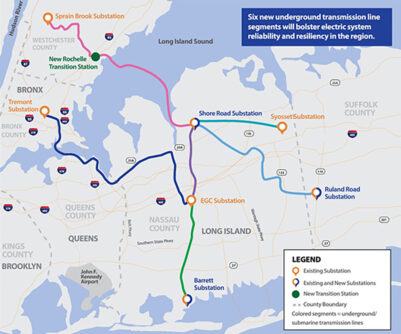
The $3.2 billion Propel NY Energy project is expected to begin construction later this year, with its preferred route running in or adjacent to 18 Nassau villages.
The project, which is a collaboration of the New York Power Authority and New York Transco, a New York developer, owner and operator of bulk electrical transmission facilities, intends to improve the region’s electrical system and is set to install 58 miles of underground power transmission lines throughout Nassau County. It would begin in Westchester and the Bronx and cross portions of Queens, adding miles of submarine electric transmission cables, predominantly in the Hempstead Harbour and Long Island Sound.
The project would establish three ties between Long Island and the statewide power grid, mostly utilizing 345kV transmission lines. Propel expects to begin construction in 2026 and plans to be in service by May 2030.
Officials say they have a “preferred route” that the transmission lines will take within Nassau County, one that was created with the consideration of residents and municipalities.
“With this project, one of the big things that we have to do is connect between substations, hubs where the power has to go from one hub to another hub, so that it can continue power delivery in and out of the region,” Marykate Guilfoyle, the manager of media and communications for New York Transco, said.
A majority of the lines will be placed in Long Island, with just 12 miles in New York City and 12.6 miles in Westchester County. A small portion of the project will also extend into Suffolk County with a new substation to be constructed in the Town of Huntington.
Three different lines are expected to be within the Town of Hempstead.
Starting in Oceanside, Propel plans to construct a new substation by Daily Boulevard, adjacent to an existing substation. The cables will then travel northward on Long Beach Road, South Long Beach Road, back to Long Beach Road in Rockville Centre, onto North Long Beach Road in South Hempstead, to Baldwin Road and Henry Street, onto Peninsula Boulevard in Hempstead, east on Fulton Avenue, north on Oak Street and onto Commerical Avenue in Uniondale, where there is an existing hub.
From the Uniondale hub, one line will head west on Stewart Avenue into Garden City before traveling north on Franklin Avenue and pivoting on Old Country Road into Mineola. Once in the Town of North Hempstead, the line will continue north on Willis Avenue, crossing through Williston Park, Albertson and Searingtown, onto Mineola Avenue in Roslyn Heights, Roslyn Estates and Roslyn, and westward on Northern Boulevard until reaching Queens, traveling through the communities of Flower Hill, Munsey Park, Manhasset, Thomaston, University Gardens, Lake Success and Russell Gardens.
Another line will travel from the Uniondale hub onto Stewart Avenue and Clinton Road, before traveling north on Glen Cove Road, intersecting through the communities of Garden City, Carle Place, Westbury, Old Westbury, East Hills, Greenvale and Roslyn Harbor before crossing into the Town of Oyster Bay.
The Town of Oyster Bay has the most transmission lines that run through it. The line extending from Glen Cove Road continues north into Glenwood Landing, pivoting from Glen Cove Road to Glen Cove Avenue through Back Road, before turning west on Glenwood Road and south onto Shore Road, where another substation is planned to be constructed.
The Shore Road substation will connect to an underwater segment, as well as two other underground segments, one that will travel throughout the town to Syosset and another that connects to the Town of Huntington hub.
The “Syosset to Shore Road Segment” will travel from an existing Syosset substation, located near the Syosset High School, heading west along South Woods Road, Syosset-Woodbury Road, Cold Spring Road and Muttontown Eastwoods Road before heading north on Route 106. The line then turns west on Northern Boulevard, heads northwest on Cedar Swamp Road, continues onto Glen Head Road, Railroad Avenue, Station Plaza and Kissam Lane before going to the Shore Road substation. This line passes by the communities of Woodbury, Syosset, Muttontown, East Norwich, Upper Brookville, Old Brookville, Glen Head and Glenwood Landing.
The “Ruland Road to Shore Road Segment” crosses into Nassau County at Bethpage-Sweet Hollow Road, heads west along Old Bethpage Road and Hypath Avenue before turning north on Grohmans Lane. The line then turns west on Old Country Road and travels north along South Elm Street, Plainview Road, East Street, Miller Road, Ronald Avenue, Vincent Avenue, Miller Place and Marlene Drive before turning northwest onto Robbins Lane. The cable then turns southwest onto Jericho Turnpike before traveling west along Old Jericho Turnpike and Old Cedar Swamp Road. It then connects to Cedar Swamp Road and follows the same path as the “Syosset to Shore Road Segment” until reaching the Shore Road substation. This path travels through the communities of Old Bethpage, Bethpage, Plainview, Hicksville, Jericho, Brookville, Upper Brookville, Old Brookville, Glen Head and Glenwood Landing.
In total, 15 miles of lines are planned in North Hempstead, 12 miles in Hempstead and 31 miles in Oyster Bay. There are an additional 6.5 miles of submarine lines planned through the Long Island Sound.
The transmission lines are planned to be placed under existing public right-of-ways and utility properties throughout the county, according to Propel officials.
Officials said they worked with local municipalities, businesses, officials and residents to determine its preferred route, saying the goal was to minimize potential construction conflicts and adhere to the wants of residents.
Propel said routing changes were made by a residential neighborhood off Searington Drive in Syosset and by Clinton Road in Hempstead for those reasons.
Propel has said the state Independent System Operator released reports projecting an increased risk of power disturbances beginning as soon as next year on Long Island due to both generation and transmission constraints and that it is clear that its project is needed to help ensure the lights and heat or air conditioning stay on.
Propel officials said the project will use 345kV underground transmission technology that has “been safely and successfully built and operated across the country for decades. New York State has 831 miles of underground transmission, including 241 miles of 345kV lines.”
Propel was awarded the bid for the project in 2023 and has since done pre-permitting outreach and survey work, and is now in the permitting process.
“A project like this requires a lot of regulatory review and approval through various permitting mechanisms,” Shannon Baxevanis, the director of communications and public affairs for New York Transco, said.
She said the Article VII permit is one of the largest hurdles before construction, which Propel has been involved in settlement negotiations since May 2025. She said Propel is hoping for a settlement to be reached within the coming weeks, which would allow Propel to seek a Certificate of Environmental Compatibility and Public Need.
Baxevanis said the hope is for that to be certified sometime in mid-2026.
The next phase would get specific instructions and routes of the project approved before construction begins.
“We would be looking to advance this to the public sometime later this year,” Baxevanis said.
Propel is also actively pursuing local, state and federal permits for the project.
Baxevanis said construction is expected to begin later this year, with 50 to 150 feet of cables being put into the ground each day.
“We’d be in one area and continue to move onto the next, sort of like a train,” Baxevanis said, as Propel hopes construction won’t stay in one area for a prolonged period of time.
Guilfoyle said local businesses and residents will be contacted throughout the construction process to provide them with up-to-date information and allow them to give feedback to Propel.