


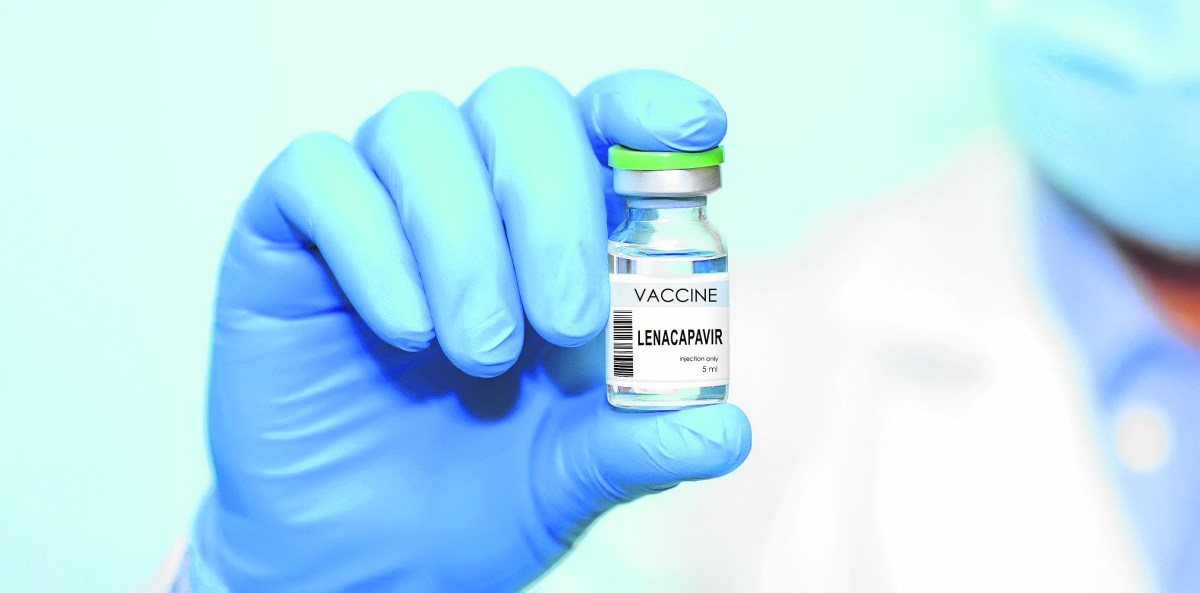
The U.S. Food and Drug Administration (FDA) recently approved a groundbreaking new option for preventing HIV, the virus that causes AIDS.
The injectable drug lenacapavir was approved in June and is now recommended by the Centers for Disease Control and Prevention (CDC) as a pre-exposure prophylaxis (PrEP) option for at-risk HIV-negative people. It offers near-complete protection against HIV — and needs to be administered only twice a year.
This long-acting treatment represents a major advancement over existing PrEP options, which include daily pills and bimonthly injections. Experts say lenacapavir could make HIV prevention more accessible and realistic for people who struggle with medication adherence.
A GAME CHANGER FOR PREVENTION
“AIDS prevention is an area we want to keep promoting as much as possible,” says Dr. Joseph McGowan, medical director of the HIV service line at Northwell Health. “Lenacapavir is a valuable addition to our toolkit to prevent HIV. It’s highly effective, and the fact that you only need it every six months is an important benefit.”
Clinical trials found lenacapavir to be nearly 100% effective in protecting HIV in sexually active men, women, transgender, and nonbinary individuals, and there were no serious safety concerns.
“Adherence to medication is one of the biggest challenges in HIV prevention,” McGowan says. “Many of the people who could benefit from PrEP are young and not used to taking daily medications. The twice-yearly injection removes that burden and reduces the stigma — you don’t have to worry about having pills lying around where parents or a partner could find them.”
Dr. Sarath Nath, assistant professor of infectious diseases and director of the STI Center for Suffolk County at Stony Brook Medicine, agrees that lenacapavir represents a paradigm shift.
“It’s easier to comply with lenacapavir, since it’s given just two times a year; it’s hard to get people to take time off from work to visit the doctor and take pills when they’re not sick,” he says. “The challenge now is making sure people who are at risk are getting the treatment.”
READ ALSO: Neurosurgery practice to move into former PBA office
EXPANDING OPTIONS AND FLEXIBILITY
Both experts emphasized that the approval of lenacapavir gives healthcare providers greater flexibility to personalize HIV prevention.
For some people, a daily pill is the preferred choice, especially now that there are affordable generic options, McGowan says. On-demand PrEP is another pill option for people who only have intermittent periods of risk, such as when they travel or when a partner is in town. And for those who don’t want to take medication frequently, lenacapavir offers a convenient, long-acting option.
Despite its promise, however, lenacapavir is not yet widely accessible. The drug costs around $25,000 to $30,000 per year, and as an injectable, it can fall under either a medical or pharmacy benefit, depending on the insurer. This creates a patchwork of coverage that complicates adoption.
“It’s becoming more available, but whenever a new drug enters the market, it takes time to be added to formularies,” McGowan explains. “If it’s covered under the medical benefit, the practice has to purchase it up front, which many can’t afford. The good news is that New York State Medicaid now covers it under the pharmacy benefit.”
Still, Nath cautions that cost remains a major barrier. “Some insurance plans don’t cover it, and for others, there is a prior authorization process,” he says.
SIDE EFFECTS AND ONGOING MONITORING
Both physicians describe lenacapavir as very well tolerated. The most common side effect is mild to moderate injection-site reactions, such as small nodules under the skin where the medication slowly releases over time.
“Less than 1% of people find it bothersome enough to stop the medicine,” McGowan says.
Nath adds that while the efficacy is extremely high, it’s not absolute. “In one clinical trial, two people out of more than 2,000 still acquired HIV even though their drug levels were fine,” he says. “There isn’t a 100% guarantee that you will not get HIV. “
BRIDGING THE UPTAKE GAP
Many people who could benefit from PrEP are not currently using it. Men who have sex with men, individuals who engage in transactional sex (exchanging sex for money, gifts, or material goods), and those who have a partner with HIV are at particularly high risk of contracting HIV through sex, Nath says. The CDC recommends that healthcare providers inform all sexually active adults and adolescents about proven options for PrEP and prescribe PrEP to anyone who requests it.
“We need to do a better job getting PrEP to the people who need it, getting people to recognize they need it and, once they’re on it, retaining them,” McGowan says. “There are disparities; PrEP uptake is disproportionately lower in the Hispanic and Black communities and among women.”
As awareness of lenacapavir spreads and access improves, experts hope this long-acting breakthrough will bring the world closer to what once seemed impossible: an end to the AIDS epidemic.