


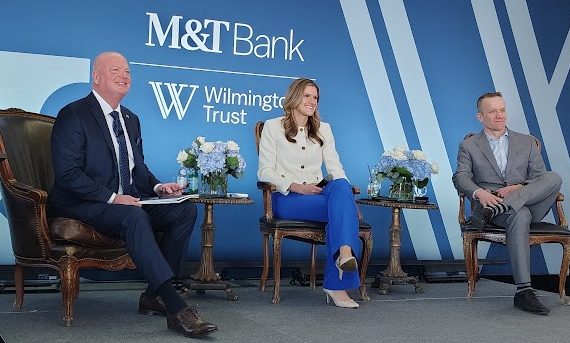
Wilmington Trust presented its 2026 Capital Markets Forecast to about 200 clients and prospective clients at Oheka Castle in Huntington. Attendees – including commercial business owners, real estate developers and high-net-worth families – gathered for a gourmet breakfast and lively networking session ahead of the presentation, which centered on the theme “Economic Experimentation: Trade, Labor and Debt Under the Microscope.”
Jim O’Hoppe, president of Wilmington Trust’s tri-state region, welcomed guests and introduced moderator Dan Shaughnessy, head of the Long Island division. Shaughnessy was joined by Wilmington Trust colleagues Meghan Shue, chief investment strategist, and Luke Tilley, chief economist, who served as featured speakers.
The presenters explained that the theme was selected to reflect the nation’s current period of economic experimentation in the areas of trade policy, labor markets and government debt. They emphasized that the term “experimentation” was not intended to carry a negative connotation, noting there have been previous periods of experimentation that have produced positive economic outcomes.
“For 2026, we have a balanced outlook,” Shue said, citing a resilient economy with strong momentum and anticipated stimulus from tax refunds, which are expected to support consumer spending. She cautioned, however, that there are warning signs – particularly within the labor market.
“The labor market is what’s keeping me up at night,” Tilley said, pointing to data showing trends in non-government and non-healthcare employment from 1990 to the present. Job growth has declined over the past six to eight months, mirroring patterns seen ahead of the recessions in 2001 and 2008. Tilley attributed the slowdown to several factors, including uncertainty related to high tariffs, reduced immigration affecting workforce growth and increased corporate investment in artificial intelligence (AI), which has allowed technology to replace certain jobs. “We expect slow economic growth due to slow job growth this year as we adjust to a new paradigm,” he said.
Shue noted that Wilmington Trust remains “fully invested in the equity market,” citing continued strength in equities and expectations for the bull market to persist, driven in part by robust earnings growth in the technology sector. She highlighted industrial automation, AI software, cybersecurity, and private equity and debt as particularly attractive areas for investment.
“We’re bullish on investments across the AI ecosystem, which has many layers,” Shue said. These include semiconductors, hyperscalers, data centers, energy and utilities, intelligence platforms, applications and adopters. “Adopters of AI technology represent the largest – and least tapped – investment opportunity,” she added.

Tariffs continue to influence economic conditions, though their impact has been less severe than initially anticipated. “Tariffs are taxes, and they have affected both businesses and consumers, but not to the extent we expected last April,” Tilley said. He cited new trade agreements and the rerouting of trade to lower-tariff channels as mitigating factors. Overall, he said, inflation continues to decelerate, with goods prices rising while services prices have declined amid multiple pressures.
One objective of the tariff policy has been to reshore manufacturing activity. Tilley said some reshoring is likely, though with limited job creation. Manufacturing gains are expected primarily in capital-intensive industries such as semiconductors, rather than labor-intensive sectors. “Globalization and automation have been highly profitable for manufacturers, and reversing those trends presents a significant hurdle,” he said, noting that reshoring will be selective and gradual.
“With a slowing labor market and moderating inflation, we expect the Federal Reserve to cut interest rates three times this year,” Tilley added.
Both labor demand and labor supply are declining. Supply has been constrained by a low birth rate and policies that have sharply curtailed both legal and illegal immigration, while demand has been reduced in part by advances in AI. “Economic growth is a combination of labor force growth and productivity growth,” Tilley said. “If you don’t have labor growth, you have to make it up in your productivity.” He added that widespread adoption of AI underpins a strong forecast for productivity gains.
While AI adoption is expected to continue causing short-term job losses, it is also likely to create new types of employment over the long term. “It’s easy to identify the jobs being eliminated, but it’s harder to conceive of the jobs AI will create,” Tilley said, adding that the timing of when long-term job creation will outweigh short-term displacement remains uncertain.
High levels of government debt relative to GDP also present concerns. “We don’t typically see deficits this large during periods of economic expansion,” Tilley said. However, he expressed optimism that productivity gains driven by AI could help reduce debt over time, citing the late 1990s as an example when rapid productivity growth, fueled by the personal computing and internet boom, contributed to debt reduction.